Demurrage vs detention is an important topic for importers and exporters because both charges can increase the total cost of a container shipment. Although the two terms are often used together, they refer to different periods of container use and different situations.
Understanding the difference between demurrage and detention can help businesses plan container movements, complete customs clearance on time, arrange transportation efficiently, and avoid unnecessary charges.
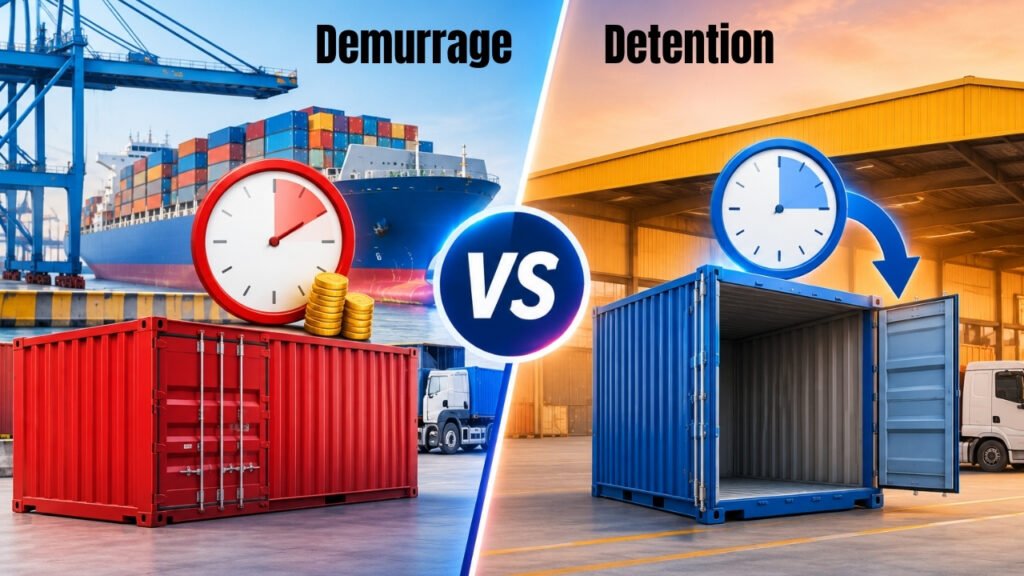
In simple terms, demurrage generally relates to keeping a container at the port or terminal beyond the allowed free time, while detention generally relates to keeping the carrier’s container outside the terminal beyond the allowed free time.
This guide explains demurrage vs detention, how the charges work, what causes them, how they are calculated, and practical ways importers and exporters can reduce the risk of paying extra container charges.
Introduction
Container shipping involves several deadlines that importers and exporters need to manage carefully. One of the most important is the free time allowed for using a container.
If a container remains at a terminal for too long, demurrage may apply. If the container has already been collected but is returned late to the carrier, detention may apply.
The exact terminology, free-time period, and charging rules can vary depending on the carrier, port, terminal, shipment type, and applicable agreement.
That is why businesses should always check the specific terms provided for their shipment instead of assuming that every carrier uses identical rules.
1. What Is Demurrage?
Demurrage is generally a charge that applies when an import container remains inside a port or terminal beyond the agreed free-time period.
Once the free time expires, the shipping line may charge the container owner or responsible party for each additional day the container remains at the terminal.
How Does Demurrage Work?
The basic process can be understood as follows:
- The container arrives at the destination terminal.
- The carrier provides a certain amount of free time.
- The importer completes the required customs and documentation procedures.
- The importer arranges transportation to collect the container.
- If the container remains at the terminal after free time expires, demurrage may apply.
Example of Demurrage
Suppose an import container arrives at a destination port and the shipment has three days of free time.
If the importer does not collect the container within those three days and the container remains at the terminal, additional demurrage charges may start from the applicable chargeable day.
The actual charge depends on the carrier’s tariff and shipment terms.
2. What Is Detention?
Detention is generally a charge that applies when an importer or exporter keeps a carrier-owned container outside the terminal beyond the allowed free time before returning the empty container.
Unlike demurrage, which generally relates to the container remaining inside the terminal, detention generally relates to the container remaining outside the terminal after it has been collected.
How Does Detention Work?
- The importer collects the loaded container from the terminal.
- The container is transported to the warehouse or delivery location.
- The cargo is unloaded.
- The empty container needs to be returned to the designated location.
- If the empty container is returned after the allowed free time, detention may apply.
Example of Detention
Suppose an importer collects a container from the port and has a specific number of free days to unload the cargo and return the empty container.
If the importer takes longer than the permitted period to unload the container or arrange its return, detention charges may apply.
3. Demurrage vs Detention: What Is the Difference?
The easiest way to understand demurrage vs detention is to look at where the container is and what stage of the shipment it is in.
| Point |
Demurrage |
Detention |
| General situation |
Container remains at the terminal beyond free time |
Container remains outside the terminal beyond free time |
| Typical stage |
Before the container is collected |
After the container is collected |
| Main concern |
Delayed pickup from terminal |
Delayed return of empty container |
| Common cause |
Customs clearance or delayed transport arrangement |
Slow unloading or delayed empty-container return |
| Charge starts |
After applicable terminal free time expires |
After applicable equipment free time expires |
Simple Way to Remember the Difference
Demurrage = container stays at the terminal too long.
Detention = container stays with the customer too long before being returned.
However, terminology and charging practices can vary between carriers and contracts. Always check the specific carrier’s terms for the shipment.
4. What Is Free Time in Container Shipping?
Free time is the period during which a container can remain in a particular situation without the applicable demurrage or detention charge being applied.
The amount of free time is not necessarily the same for every shipment.
What Can Affect Free Time?
- Shipping line
- Port or terminal
- Origin or destination
- Container type
- Trade route
- Contract terms
- Customer agreement
- Import or export conditions
Why Is Free Time Important?
Free time gives the importer or exporter a limited period to complete the required activities without incurring the relevant container-use charge.
For import shipments, this may involve completing customs clearance, arranging transportation, collecting the container, unloading the cargo, and returning the empty container within the applicable period.
Businesses should confirm the exact free-time terms before the shipment arrives rather than waiting until the container is already at the terminal.
5. How Are Demurrage and Detention Charges Calculated?
Demurrage and detention charges are generally calculated according to the applicable carrier tariff, agreement, container type, and number of chargeable days.
Basic Calculation
A simple way to understand the calculation is:
Extra Charge = Chargeable Days × Daily Rate
However, actual carrier tariffs can be more complicated. Some carriers may use different rates for different periods or container types.
Example Calculation
Suppose a shipment has:
- 3 days of free time
- 4 chargeable days after free time
- A daily charge of $50
The illustrative additional charge would be:
4 × $50 = $200
This is only an example. Actual demurrage and detention rates vary by carrier, location, container type, contract, and shipment terms.
6. Common Causes of Demurrage and Detention
There are several reasons why importers and exporters may incur container-related charges.
1. Delayed Customs Clearance
One of the common causes of import delays is incomplete or delayed customs documentation.
If customs clearance is not completed in time, the container may remain at the terminal and demurrage can potentially accumulate.
2. Missing Documentation
Missing or incorrect documents can delay the release of cargo.
Examples may include:
- Commercial invoice
- Packing list
- Bill of lading
- Import permits
- Certificates
- Customs documentation
3. Delayed Transport Arrangement
Even after cargo is ready for collection, a lack of available trucks or transportation arrangements can delay container pickup.
4. Warehouse Delays
After collecting a container, the importer needs to unload the cargo and arrange the empty-container return.
If the warehouse is not ready, the container may remain in use longer than planned.
5. Poor Shipment Planning
Failure to monitor vessel arrival times, customs status, trucking schedules, and empty-container return instructions can increase the risk of additional charges.
7. Demurrage and Detention Examples
Example 1: Import Demurrage
An import container arrives at the destination terminal.
The importer has limited free time to collect the container. However, customs clearance is delayed because additional documentation is required.
The container remains at the terminal after the free-time period ends.
In this situation, demurrage may apply according to the carrier’s applicable tariff.
Example 2: Import Detention
The importer successfully collects the container from the terminal within the permitted time.
However, the warehouse is not ready to unload the cargo, and the container remains at the customer’s premises for longer than the allowed period.
If the empty container is returned after the applicable free time, detention may apply.
Example 3: Both Charges
A shipment can potentially experience both types of charges at different stages.
For example, a container may first remain at the terminal beyond the applicable free time and incur demurrage. After collection, it may also remain outside the terminal too long before the empty container is returned, resulting in detention.
This demonstrates why shipment planning needs to cover the complete container journey.
8. How to Avoid Demurrage and Detention Charges
Importers and exporters can reduce the risk of additional charges by planning each stage of the shipment before the container arrives.
1. Prepare Customs Documents Early
Make sure the required customs and commercial documents are prepared before the shipment arrives whenever possible.
- Check commercial invoices.
- Verify packing lists.
- Confirm product descriptions.
- Check required permits and certificates.
- Review customs information.
2. Monitor the Vessel and Container
Track the shipment and monitor the estimated arrival time.
Knowing when the container is expected to arrive allows the importer to prepare customs clearance and transportation arrangements in advance.
3. Arrange Trucking Before Arrival
Do not wait until the container has already arrived before looking for transportation.
Arrange the appropriate truck and delivery schedule in advance where possible.
4. Confirm the Free-Time Period
Ask the carrier or logistics provider to confirm the applicable free-time terms.
Keep a record of:
- Free-time allowance
- Free-time start date
- Free-time end date
- Container pickup deadline
- Empty-container return deadline
5. Prepare the Warehouse
If the container is going to a warehouse, make sure the facility is ready to receive and unload the cargo.
Coordinate:
- Delivery appointment
- Unloading team
- Storage space
- Handling equipment
- Empty-container return
6. Plan the Empty-Container Return
Do not treat the empty-container return as an afterthought.
Confirm where the empty container must be returned and what deadline applies.
7. Monitor the Shipment Daily
For time-sensitive shipments, regularly monitor customs status, container availability, trucking arrangements, and empty-container return instructions.
9. How a Freight Forwarder Can Help
A freight forwarder can help coordinate different parts of the international shipping process and keep the importer or exporter informed about important shipment milestones.
For businesses that need support with international cargo movement,
freight forwarding services can help coordinate transportation, documentation, and communication between different parties involved in the shipment.
Areas a Freight Forwarder May Help With
- Shipment planning
- Documentation coordination
- Shipment tracking
- Carrier communication
- Transportation arrangements
- Customs coordination
- Container movement
- Delivery planning
For ocean shipments, understanding the complete
sea freight process can also help businesses plan container movements more effectively.
Customs delays are another important factor. Businesses can review
customs clearance services to understand how customs procedures can affect the movement of imported cargo.
10. Demurrage and Detention Checklist
Use this checklist before and during an import shipment to reduce the risk of unexpected container charges.
| Check |
What to Confirm |
| Free time |
Confirm the applicable free-time period. |
| Arrival |
Monitor the estimated container arrival date. |
| Customs |
Prepare and submit required documentation on time. |
| Trucking |
Arrange transportation before the container is available. |
| Warehouse |
Make sure the warehouse is ready to unload the container. |
| Container return |
Confirm the empty-container return location and deadline. |
| Tracking |
Monitor container status and important deadlines. |
| Charges |
Check the carrier tariff if free time is exceeded. |
Conclusion
Understanding demurrage vs detention is important for any business involved in container shipping.
Demurrage generally relates to a container remaining at the terminal beyond the applicable free time, while detention generally relates to keeping the carrier’s container outside the terminal beyond the permitted period before returning it.
Although the terminology and charging practices can vary between carriers and shipment agreements, the basic distinction is useful for planning container movements.
The best way to avoid unnecessary charges is to prepare documents early, monitor shipment milestones, arrange transportation in advance, confirm free-time terms, prepare the warehouse, and plan the empty-container return.
Good shipment planning can help importers and exporters reduce delays and better control their overall logistics costs.
Frequently Asked Questions
1. What is the difference between demurrage and detention?
Demurrage generally applies when a container remains at the port or terminal beyond the allowed free time. Detention generally applies when a carrier-owned container remains outside the terminal beyond the allowed free time before the empty container is returned.
2. How can I avoid demurrage charges?
Prepare customs documents early, monitor the container arrival, arrange transportation in advance, and make sure the container is collected within the applicable free-time period.
3. How can I avoid detention charges?
Plan the delivery and unloading process carefully, make sure the warehouse is ready, and arrange the empty-container return before the permitted free time expires.
4. Can a shipment have both demurrage and detention charges?
Yes. A shipment can potentially incur demurrage while the container remains at the terminal and detention later if the container is kept outside the terminal beyond the applicable free time.
5. Who pays demurrage and detention charges?
The party responsible for the charges depends on the shipping contract, booking terms, carrier agreement, and circumstances of the shipment. Importers and exporters should check their specific shipping terms to understand their responsibility.