
How to Read a Shipping Container…
How to Read a Shipping Container Number: A Simple Guide A shipping container number is…

END TO END Solution
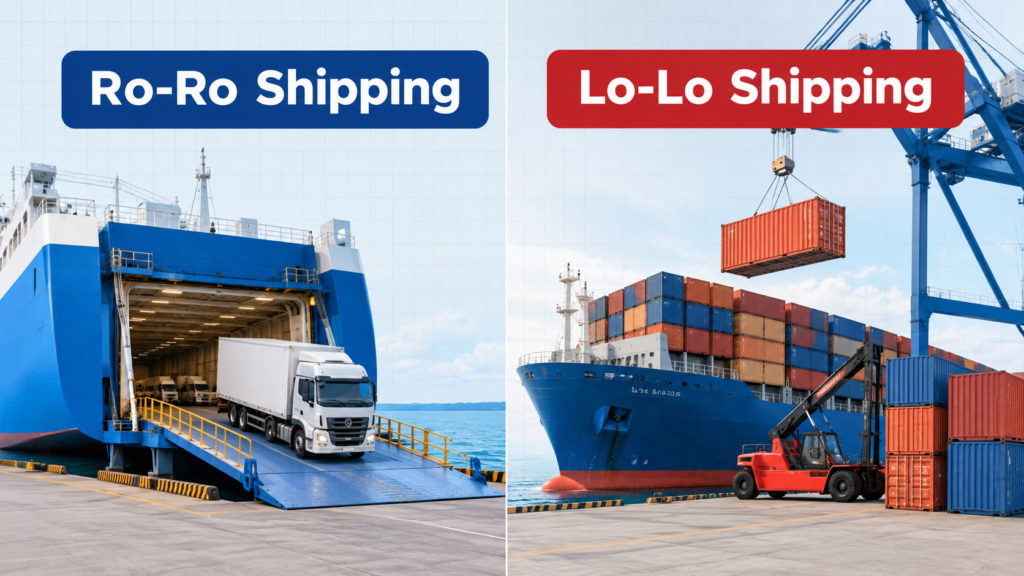
Ro-Ro and Lo-Lo are two important methods used to load and unload cargo at ports. Although both are designed to move cargo efficiently between the terminal and vessel, they use very different handling methods.
Ro-Ro stands for Roll-on/Roll-off, while Lo-Lo stands for Lift-on/Lift-off. The main difference is how cargo is transferred onto and off the vessel.
Ro-Ro cargo is generally driven or rolled onto the vessel using ramps, while Lo-Lo cargo is lifted using cranes or other lifting equipment.
In this guide, we explain how Ro-Ro and Lo-Lo shipping work, the types of cargo they handle, their advantages and disadvantages, and how to decide which method may be suitable for different shipments.
Table of Contents
Ports handle many different types of cargo, from cars and trucks to machinery, containers, project cargo, and heavy industrial equipment.
Because cargo comes in different shapes, sizes, and weights, ports use different loading and unloading methods.
Two common methods are Ro-Ro and Lo-Lo.
For businesses involved in sea freight services, understanding the difference between these methods can help when planning cargo transportation and selecting an appropriate shipping service.
Ro-Ro stands for Roll-on/Roll-off.
In Ro-Ro shipping, cargo is loaded onto and unloaded from a vessel by rolling or driving it through a ramp or similar access system.
Instead of being lifted vertically by a crane, the cargo generally moves horizontally between the terminal and the vessel.
A typical Ro-Ro operation may involve:
This method is particularly useful for cargo that can move on wheels or be transported on specialized wheeled equipment.
Ro-Ro vessels are designed with access arrangements that allow cargo to move between the terminal and the vessel.
Depending on the vessel and cargo, ramps may provide access to different decks or loading areas.
Terminal → Ramp → Vessel → Ramp → Destination Terminal
The cargo does not necessarily need to be lifted by a ship-to-shore crane in the same way as conventional containerized cargo.
This can make Ro-Ro particularly suitable for vehicles and other mobile cargo.
Ro-Ro shipping is commonly associated with cargo that can be driven, rolled, or otherwise moved on wheels.
Examples include:
Some Ro-Ro vessels can also carry cargo that is loaded using specialized equipment rather than being driven directly.
Lo-Lo stands for Lift-on/Lift-off.
In Lo-Lo shipping, cargo is lifted onto and off the vessel using cranes or other lifting equipment.
Unlike Ro-Ro cargo, the cargo does not need to be driven or rolled directly onto the vessel.
A typical Lo-Lo operation may involve:
Lo-Lo operations are suitable for many types of cargo, including containerized and heavy or project cargo.
Lo-Lo vessels rely on lifting equipment to transfer cargo between the vessel and the port.
Depending on the vessel and terminal, cargo may be handled using ship-to-shore cranes, mobile harbor cranes, ship cranes, or other appropriate lifting equipment.
Terminal → Crane → Vessel → Crane → Destination Terminal
The lifting equipment used depends on the cargo type, vessel design, port infrastructure, and operational requirements.
Lo-Lo shipping can handle a wide range of cargo that cannot simply be rolled onto a vessel.
Examples include:
The specific cargo that can be handled depends on the vessel’s lifting capacity, port equipment, cargo dimensions, and applicable handling procedures.
| Feature | Ro-Ro | Lo-Lo |
|---|---|---|
| Meaning | Roll-on/Roll-off | Lift-on/Lift-off |
| Loading method | Cargo is rolled or driven onto the vessel. | Cargo is lifted onto the vessel. |
| Main equipment | Ramps and cargo-handling equipment. | Cranes or other lifting equipment. |
| Typical cargo | Vehicles and wheeled equipment. | Containers, machinery, breakbulk, and heavy cargo. |
| Handling direction | Primarily horizontal movement. | Vertical lifting followed by positioning. |
| Container cargo | Not the primary use of conventional Ro-Ro operations. | Commonly handled using cranes. |
| Specialized cargo | Suitable for mobile cargo. | Suitable for cargo requiring lifting. |
Vehicles can be driven directly onto the vessel, which can make loading and unloading efficient for suitable cargo.
Ro-Ro is particularly useful for vehicles, trailers, and mobile machinery.
Because cargo can enter and leave through ramps, conventional crane lifting may not be required for every cargo movement.
The rolling method can support efficient loading and unloading when the vessel, terminal, and cargo are properly configured for Ro-Ro operations.
Ro-Ro is not suitable for every type of cargo. Cargo generally needs to be mobile or capable of being moved using suitable wheeled equipment.
Ro-Ro operations require appropriate ramps, vessel access arrangements, and terminal facilities.
Vehicles and wheeled cargo require suitable internal vessel space and securing arrangements.
Lo-Lo operations can handle many different cargo types, including containers, machinery, steel, and project cargo.
Heavy and oversized cargo can be lifted when the vessel and lifting equipment have sufficient capacity.
Cranes can handle cargo that cannot be moved directly on wheels.
Lo-Lo operations require suitable lifting equipment with sufficient capacity and reach.
Loading and unloading can involve multiple lifting operations, depending on the cargo and terminal setup.
Port infrastructure and crane availability can affect operational planning.
The appropriate method depends primarily on the type of cargo, vessel availability, port infrastructure, destination, cost, and operational requirements.
In practice, the final choice should be based on the actual cargo characteristics and the available shipping services.
An automobile manufacturer needs to export 100 vehicles internationally.
Because the vehicles can be driven onto a specialized vessel, Ro-Ro shipping may be an appropriate option.
The vehicles can be driven onto the vessel, secured in designated areas, transported, and then driven off at the destination.
An exporter needs to ship a large industrial machine that cannot be driven onto a vessel.
A Lo-Lo operation may be suitable because the machine can be lifted using an appropriate crane and secured on the vessel.
An exporter has several containers of general cargo for international transportation.
Lo-Lo container shipping is the conventional method because containers are lifted between the terminal and vessel using cranes or other suitable equipment.
Before choosing between Ro-Ro and Lo-Lo shipping, consider:
| Check | What to Confirm |
|---|---|
| Cargo type | Determine whether the cargo is wheeled, containerized, breakbulk, or project cargo. |
| Cargo dimensions | Check length, width, height, and overall size. |
| Cargo weight | Confirm the total cargo weight and lifting requirements. |
| Loading method | Determine whether the cargo can be rolled or needs to be lifted. |
| Port facilities | Check whether the origin and destination ports support the required operation. |
| Vessel availability | Confirm suitable Ro-Ro or Lo-Lo services are available. |
| Cargo securing | Confirm appropriate securing arrangements are available. |
| Cost and transit | Compare the available service options, costs, and transit requirements. |
The main difference between Ro-Ro and Lo-Lo shipping is the way cargo is loaded and unloaded.
Ro-Ro means Roll-on/Roll-off, where suitable cargo is generally driven or rolled onto and off the vessel using ramps.
Lo-Lo means Lift-on/Lift-off, where cargo is lifted onto and off the vessel using cranes or other lifting equipment.
Ro-Ro is particularly suitable for vehicles and wheeled machinery, while Lo-Lo can handle containers, machinery, breakbulk, project cargo, and other cargo that requires lifting.
Choosing the right method depends on the cargo type, dimensions, weight, port facilities, vessel availability, handling requirements, and overall shipping plan.
Businesses involved in international cargo movement can also review freight forwarding services to understand how cargo transportation and logistics arrangements can be coordinated.
Ro-Ro stands for Roll-on/Roll-off. It refers to a cargo handling method where suitable cargo is rolled or driven onto and off a vessel, generally using ramps.
Lo-Lo stands for Lift-on/Lift-off. It refers to a cargo handling method where cargo is lifted onto and off a vessel using cranes or other lifting equipment.
Ro-Ro is particularly suitable for cars, trucks, buses, trailers, construction equipment, agricultural machinery, and other wheeled cargo.
Lo-Lo can be used for containers, machinery, industrial equipment, breakbulk cargo, project cargo, and heavy cargo that requires lifting.
Conventional container shipping is generally handled using Lo-Lo operations, with containers lifted between the terminal and vessel using cranes or other suitable lifting equipment.
Ro-Ro can provide efficient loading and unloading for suitable wheeled cargo, but actual handling time depends on the vessel, terminal, cargo volume, port operations, and other operational factors.
Consider whether the cargo can be rolled or driven, its size and weight, the required handling equipment, port facilities, available vessel services, cargo securing requirements, cost, and transit needs.
Speak with our team to find the best shipping solutions for your business.
+230 52583493
How to Read a Shipping Container Number: A Simple Guide A shipping container number is…
Freight Prepaid vs Freight Collect: What Exporters Need to Know Freight Prepaid and Freight Collect…
7 Types of Bill of Lading Every Exporter Should Know A Bill of Lading, commonly…
Let’s work together to simplify your logistics and ensure fast, secure, and timely delivery of your shipments.

Your Trusted Partner in End-to-End Supply Chain Management, Offering Expertise, Reliability, and On-Time Delivery Across the Globe.