

How to Read a Shipping Container…
How to Read a Shipping Container Number: A Simple Guide A shipping container number is…

END TO END Solution
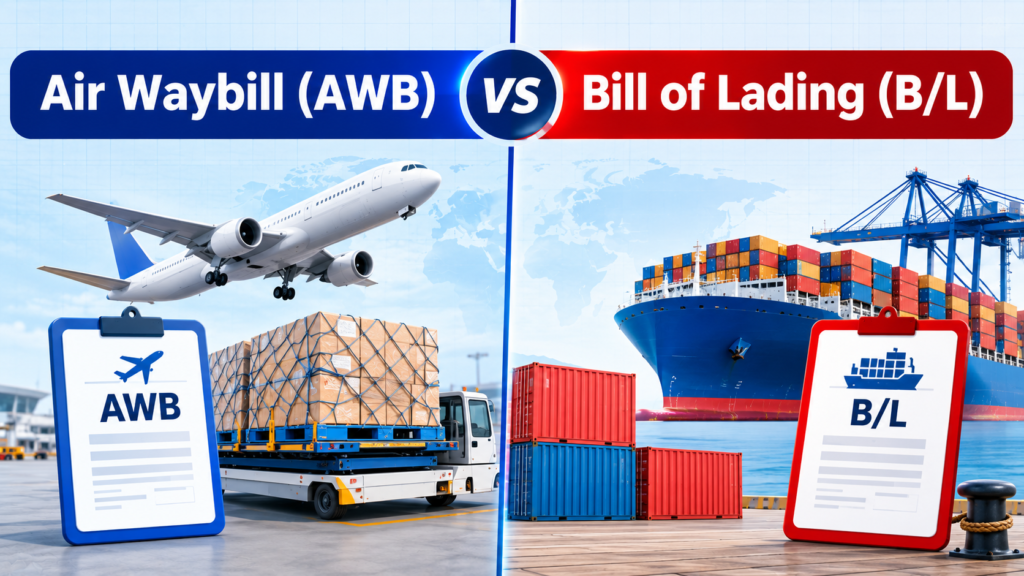
An Air Waybill (AWB) and a Bill of Lading (B/L) are important transportation documents used in international trade. Although both provide evidence of a transportation contract and contain important shipment information, they are used for different modes of transport and have important legal and operational differences.
An Air Waybill is used for air cargo shipments, while a Bill of Lading is primarily used for ocean freight and can also be used in other forms of transportation depending on the document and applicable rules.
One of the most important differences is that a standard AWB is generally not a document of title, whereas a negotiable ocean Bill of Lading can function as a document of title.
In this guide, we explain what an AWB and Bill of Lading are, how they work, their key differences, important information included in each document, and how exporters and importers can determine which document applies to their shipment.
Table of Contents
International shipments require accurate transportation and commercial documentation. These documents help carriers, exporters, importers, customs authorities, banks, and logistics providers understand what is being shipped and under what transportation arrangement.
Two of the most commonly used transportation documents are the Air Waybill and the Bill of Lading.
For air cargo, the AWB provides shipment and transportation information between the shipper and air carrier or freight forwarder.
For ocean cargo, the Bill of Lading provides important information about the shipment and the contractual relationship between the carrier and the relevant parties.
Businesses using sea freight services or international air cargo should understand these documents because incorrect or incomplete transportation documentation can cause delays in cargo release, customs processing, or delivery.
An Air Waybill (AWB) is a transportation document used for air cargo shipments.
It is generally issued by an airline or freight forwarder and contains important details about the shipment, shipper, consignee, origin, destination, cargo, and transportation arrangements.
The AWB serves several purposes, including:
A standard AWB is generally non-negotiable and is not a document of title.
An AWB commonly includes:
A typical air cargo shipment may follow these steps:
The AWB number can also be used to identify and track the shipment through the relevant carrier or logistics provider.
A Bill of Lading (B/L) is a transportation document commonly used for ocean freight.
It can serve as:
The Bill of Lading normally contains information about the shipper, consignee, carrier, vessel, ports, cargo, quantity, weight, and transportation terms.
A typical ocean shipment may involve:
Depending on the type of Bill of Lading and the commercial arrangement, presentation or surrender of the required document may be relevant to cargo release.
| Feature | Air Waybill (AWB) | Bill of Lading (B/L) |
|---|---|---|
| Primary mode | Air freight | Primarily ocean freight |
| Issued by | Airline or freight forwarder | Ocean carrier, NVOCC, or other applicable carrier/transport provider |
| Transport information | Airports, flight/routing information, cargo details | Ports, vessel/voyage information, container and cargo details |
| Negotiable | Generally non-negotiable | May be negotiable or non-negotiable depending on the type |
| Document of title | Generally no | A negotiable B/L can function as a document of title |
| Typical cargo | Time-sensitive, high-value, or relatively lightweight cargo | Containers, bulk, breakbulk, machinery, and other ocean cargo |
| Tracking | AWB number | B/L, booking, container, or shipment references |
| Original document requirement | Normally not required as a negotiable title document | May be required depending on B/L type and release arrangement |
Both documents provide evidence of the transportation arrangement and contain relevant terms and shipment information.
Both can provide evidence that the carrier or transportation provider has received the goods for transportation, subject to the terms and conditions of the applicable document.
AWB and B/L numbers allow carriers and logistics providers to identify and track shipments.
The documents contain information used to help carriers and handling parties process and transport the cargo.
Transportation documents may also be used alongside commercial invoices, packing lists, certificates, customs documentation, and other trade documents.
| Information | AWB | B/L |
|---|---|---|
| Shipper | Yes | Yes |
| Consignee | Yes | Yes |
| Cargo description | Yes | Yes |
| Weight | Yes | Yes |
| Origin and destination | Airports | Ports and/or inland locations where applicable |
| Flight information | Commonly included | Not applicable |
| Vessel/voyage information | Not applicable | Commonly included |
| Container number | May apply to certain unitized air cargo arrangements | Commonly included for containerized shipments |
One of the most important distinctions is the concept of a document of title.
A standard Air Waybill is generally not a document of title. The consignee named on the AWB can normally take delivery according to the carrier’s applicable procedures without the AWB functioning as a negotiable title document.
A negotiable Bill of Lading can have a different legal function. Depending on its form and applicable law, it may represent control over the goods and can be transferred or endorsed according to the relevant legal and contractual requirements.
This distinction can be particularly important in international trade transactions involving documentary collections or letters of credit.
An AWB is generally non-negotiable. It is primarily used as evidence of the contract of carriage and receipt of the cargo.
A Bill of Lading can be issued in different forms.
The exact legal effect depends on the document wording, governing law, trade terms, and transaction structure.
An exporter needs to send 500 kg of electronic components from India to Germany by air.
The exporter or its freight forwarder arranges air transportation and an Air Waybill is issued for the shipment.
The AWB identifies the shipper, consignee, airports, cargo, weight, and transportation details.
An exporter ships a container of machinery from India to the United Arab Emirates.
The shipment is booked with an ocean carrier or through a freight forwarder/NVOCC.
A Bill of Lading is issued containing the relevant shipper, consignee, vessel, port, container, cargo, and transportation information.
Several exporters provide cargo to a freight forwarder for consolidation into one airline shipment.
The airline may issue a Master Air Waybill to the forwarder, while the forwarder issues separate House Air Waybills to its customers.
The exact documentation depends on the transportation mode, carrier, trade transaction, payment method, destination, and applicable regulations.
Before finalizing an AWB or Bill of Lading, exporters should check:
The main difference between an Air Waybill and a Bill of Lading is the transportation mode and the legal function of the document.
An Air Waybill (AWB) is used for air cargo and is generally a non-negotiable transportation document that is not a document of title.
A Bill of Lading (B/L) is primarily used for ocean freight and can be negotiable or non-negotiable. A negotiable Bill of Lading can have document-of-title functions depending on its form and applicable law.
Both documents contain important information about the shipment and help carriers, exporters, importers, customs authorities, and logistics providers manage cargo transportation.
Businesses involved in international cargo movement can also review freight forwarding services to understand how transportation, documentation, customs coordination, and cargo delivery can be managed.
An Air Waybill is a transportation document used for air cargo shipments. It contains information about the shipper, consignee, cargo, origin, destination, and transportation arrangements.
A Bill of Lading is a transportation document commonly used for ocean freight. It can serve as evidence of the contract of carriage and receipt of goods and, in negotiable form, may also function as a document of title.
An AWB is used for air freight, while a B/L is primarily used for ocean freight. A standard AWB is generally non-negotiable, while a B/L may be negotiable or non-negotiable.
A standard Air Waybill is generally not a document of title.
A negotiable Bill of Lading can function as a document of title depending on its form and applicable law. Not every Bill of Lading has the same legal effect.
The document itself does not determine transportation speed. Air freight is generally faster than ocean freight, but transit time depends on the specific route, service, carrier, and shipment requirements.
Yes. A freight forwarder may issue a House Air Waybill for its customer, while the airline may issue a Master Air Waybill for the consolidated shipment.
Yes. Depending on its role and applicable regulations, a freight forwarder or NVOCC may issue a house Bill of Lading, while the ocean carrier may issue a master Bill of Lading.
A Master Air Waybill, or MAWB, is generally the air carrier’s transportation document for a consolidated or contracted air shipment.
A House Air Waybill, or HAWB, is generally issued by a freight forwarder to its customer for an individual shipment within a consolidation.
Speak with our team to find the best shipping solutions for your business.
+230 52583493
How to Read a Shipping Container Number: A Simple Guide A shipping container number is…
Freight Prepaid vs Freight Collect: What Exporters Need to Know Freight Prepaid and Freight Collect…

7 Types of Bill of Lading Every Exporter Should Know A Bill of Lading, commonly…
Let’s work together to simplify your logistics and ensure fast, secure, and timely delivery of your shipments.

Your Trusted Partner in End-to-End Supply Chain Management, Offering Expertise, Reliability, and On-Time Delivery Across the Globe.