

How to Read a Shipping Container…
How to Read a Shipping Container Number: A Simple Guide A shipping container number is…

END TO END Solution
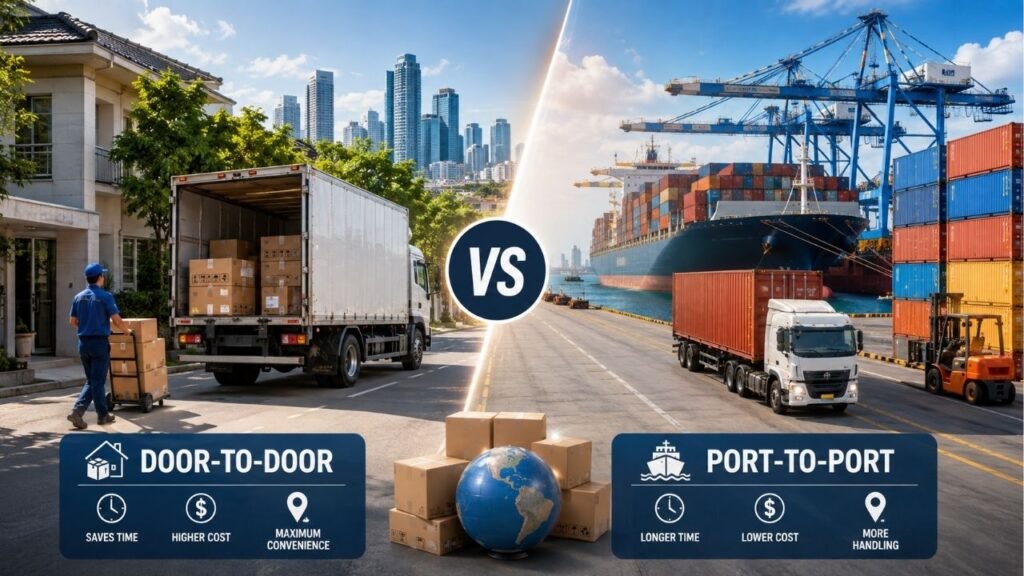
Choosing the right shipping method can have a major impact on your transportation costs, delivery time, and day-to-day logistics management. Two common options for international shipments are door-to-door shipping and port-to-port shipping.
Door-to-door shipping involves moving goods from the seller’s location directly to the buyer’s agreed delivery address. Port-to-port shipping, on the other hand, generally covers the transportation of cargo between the origin and destination ports, with the buyer or seller managing additional inland transportation.
When comparing door-to-door vs port-to-port, the cheaper option is not always the one that provides the lowest overall logistics cost. Businesses should also consider transportation coordination, customs clearance, local delivery, handling charges, and the time required to manage the shipment.
In this guide, we compare both shipping options based on cost, speed, convenience, responsibilities, customs, cargo type, and overall efficiency.
Table of Contents
Door-to-door shipping is a logistics service in which cargo is transported from the sender’s location to the recipient’s final delivery address.

Depending on the service arrangement, the logistics provider may coordinate several stages of the shipment, including pickup, transportation, customs procedures, and final delivery.
For businesses that want to reduce the amount of shipment coordination they handle internally, door-to-door shipping can provide a convenient solution.
The exact services included depend on the shipping agreement and logistics provider.
Port-to-port shipping generally refers to transportation between an origin port and a destination port.

Under this arrangement, the shipper or buyer may need to organize additional services before the cargo reaches the origin port and after it arrives at the destination port.
For example, the buyer may need to arrange:
Port-to-port shipping can be attractive to businesses with established logistics networks or companies that want greater control over each stage of transportation.
The biggest difference between door-to-door and port-to-port shipping is the scope of transportation and logistics responsibility.
Door-to-door shipping focuses on moving cargo from the origin address to the final delivery address. A logistics provider can coordinate multiple stages of transportation on behalf of the customer.
Port-to-port shipping focuses primarily on the movement of cargo between the origin and destination ports. Additional transportation and logistics activities may need to be arranged separately.
This means port-to-port shipping may provide greater control, while door-to-door shipping may provide greater convenience.
| Factor | Door-to-Door | Port-to-Port |
|---|---|---|
| Transportation Coverage | Origin to final destination | Port to port |
| Convenience | High | Requires more coordination |
| Cost | May be higher as more services are included | Can have a lower base freight cost |
| Time Management | Usually simpler to coordinate | Requires additional planning |
| Customs | Can be coordinated as part of the service | May need separate arrangements |
| Final Delivery | Included according to the agreed service | Usually arranged separately |
| Control | Less direct control over individual stages | Greater control over additional logistics |
| Best For | Businesses seeking convenience | Businesses with logistics resources |
When it comes to saving time, door-to-door shipping can have an advantage because multiple logistics stages can be coordinated through one service arrangement.
With port-to-port shipping, the business may need to separately arrange transportation before and after the main international shipment.
Port-to-port shipping can also be efficient when a business already has reliable local transportation, customs brokers, warehouses, or distribution partners at the origin and destination.
In this situation, the company may already have systems in place to move cargo quickly after it reaches the port.
There is no universal answer to which option is cheaper.
Port-to-port shipping may have a lower initial freight cost because it covers a more limited portion of the transportation journey. However, businesses must add the cost of services that are arranged separately.
These may include:
Door-to-door shipping may have a higher quoted price, but it can combine several services into one logistics arrangement.
Instead of comparing only the freight rate, businesses should compare the total logistics cost from origin to final destination.
This provides a more accurate picture of which option actually saves money.
Another important difference between door-to-door and port-to-port shipping is who manages each stage of the shipment.
Depending on the service agreement, the logistics provider may coordinate pickup, international transportation, customs clearance, and final delivery.
This can reduce the administrative workload for the shipper or buyer.
Port-to-port shipping gives the business more responsibility for arranging transportation and services outside the port-to-port movement.
This may be beneficial for companies with experienced logistics teams that already have local transportation and customs partners.
Businesses that need help coordinating international shipments can also review this freight forwarding guide to understand how freight forwarders manage different stages of the shipping process.
Customs clearance is an important part of international shipping regardless of whether you choose door-to-door or port-to-port transportation.
Under a door-to-door arrangement, customs clearance may be coordinated as part of the overall logistics service, depending on the agreed terms.
With port-to-port shipping, the importer or exporter may need to arrange customs clearance separately.
Incorrect documentation or delays in customs processing can increase the overall delivery time and cost.
Businesses should confirm the exact documentation and customs requirements for their cargo and destination.
The right shipping model can depend on the size, value, urgency, and nature of your cargo.
Large shipments may use containerized transportation. Businesses moving a full container can consider FCL shipping when the cargo volume justifies dedicated container space.
Businesses with cargo that does not require a full container may consider LCL shipping. In this case, goods share container space with cargo from other shippers.
Understanding the difference between FCL vs LCL shipping can help businesses select the appropriate container option for their shipment volume.
For urgent shipments, the transportation method itself can have a major impact on delivery time. Businesses can compare air freight vs sea freight when deciding how quickly cargo needs to reach its destination.
Both door-to-door and port-to-port arrangements can be used with containerized shipments, depending on the service provider and shipping agreement.
FCL door-to-door shipping can be useful when a business wants a container moved from the supplier’s location directly to the final destination.
This can reduce the need for the business to coordinate separate transportation stages.
FCL port-to-port shipping focuses on moving the container between the origin and destination ports. The buyer or seller may then arrange local transportation and other services separately.
LCL door-to-door shipping can provide convenience for businesses that have smaller shipments and want the logistics provider to coordinate delivery to the final address.
LCL port-to-port shipping may be suitable for businesses that have established local logistics arrangements and want greater control over transportation after the cargo reaches the destination port.
Door-to-door shipping can provide several advantages for businesses that prefer convenience and simplified logistics management.
Door-to-door can be a good option when your business wants a single logistics provider to coordinate most or all of the transportation process.
Port-to-port shipping can be attractive for businesses that already have strong logistics networks.
Port-to-port shipping can work well when your business has reliable customs brokers, trucking providers, warehouses, or distribution networks at the origin and destination.
Before selecting door-to-door or port-to-port shipping, consider the following factors.
If your team has limited experience managing international shipments, door-to-door services may simplify the process.
Compare the complete cost rather than only the international freight rate.
If delivery time is critical, choose an arrangement that provides reliable coordination from pickup through final delivery.
Determine whether your shipment requires FCL, LCL, or another transportation solution.
Consider the availability of ports, roads, warehouses, customs services, and local transportation at the destination.
If you want to manage local transportation yourself, port-to-port may provide more flexibility. If you prefer one provider to coordinate the shipment, door-to-door may be more convenient.
Consider a company importing products from China.
The supplier’s cargo is collected from the factory, transported to the export port, shipped internationally, cleared through customs, and delivered to the buyer’s warehouse.
The business has fewer transportation stages to coordinate independently.
The cargo is transported from the origin port to the destination port. After arrival, the buyer arranges customs clearance, local transportation, and final delivery.
The port-to-port option may provide greater control, but the buyer has more responsibilities to manage.
If the business values convenience and wants to reduce logistics coordination, door-to-door may be the better option.
If the business already has local logistics partners and wants greater control over costs and transportation, port-to-port may be more suitable.
When comparing door-to-door vs port-to-port, there is no single option that is best for every shipment.
Door-to-door shipping can save time and simplify logistics by coordinating transportation from the origin to the final destination. It can be especially useful for businesses that want convenience and fewer logistics responsibilities.
Port-to-port shipping can provide greater control and may offer a lower initial freight cost. It can work well for businesses with experienced logistics teams and established transportation partners.
The best choice depends on your shipment size, destination, budget, delivery deadline, logistics capabilities, and preferred level of control.
Before making a decision, compare the total logistics cost and complete delivery timeline rather than looking only at the quoted freight rate.
Door-to-door shipping is a transportation arrangement where cargo is moved from the sender’s location to the buyer’s final delivery address, with the included services depending on the agreed shipping arrangement.
Port-to-port shipping generally covers the transportation of cargo between the origin port and destination port. Additional services such as local transportation and final delivery may need to be arranged separately.
Door-to-door shipping can have a higher quoted price because it may include additional transportation and logistics services. However, the total cost can be competitive when separate port handling, customs, and local delivery charges are considered.
Door-to-door can simplify coordination and potentially reduce delays between transportation stages. However, actual delivery time depends on the route, transportation mode, customs clearance, carrier schedules, and local delivery.
Port-to-port may have a lower initial freight cost, but the buyer may need to pay separately for customs clearance, local transportation, handling, and final delivery. Comparing total logistics costs provides a better answer.
Yes. FCL containers can be transported door-to-door when the service provider offers pickup, international transportation, customs coordination, and final delivery.
Yes. LCL shipments can be arranged for door-to-door delivery depending on the logistics provider, route, destination, and agreed service.
Port-to-port shipping generally gives businesses more control over inland transportation and local logistics providers. Door-to-door shipping provides greater convenience by allowing one provider to coordinate more stages of the shipment.
Speak with our team to find the best shipping solutions for your business.
+230 52583493
How to Read a Shipping Container Number: A Simple Guide A shipping container number is…
Freight Prepaid vs Freight Collect: What Exporters Need to Know Freight Prepaid and Freight Collect…

7 Types of Bill of Lading Every Exporter Should Know A Bill of Lading, commonly…
Let’s work together to simplify your logistics and ensure fast, secure, and timely delivery of your shipments.

Your Trusted Partner in End-to-End Supply Chain Management, Offering Expertise, Reliability, and On-Time Delivery Across the Globe.