
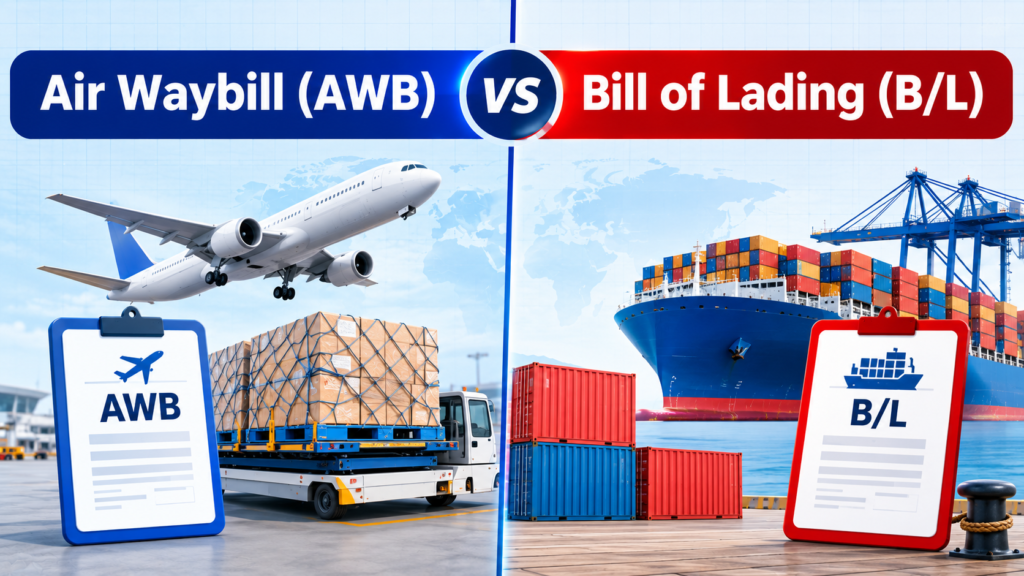
Air Waybill (AWB) vs Bill of…
Air Waybill (AWB) vs Bill of Lading (B/L): Key Differences Explained An Air Waybill (AWB)…
END TO END Solution
Every business that moves goods from one place to another needs a logistics plan. But not every business handles this the same way. Some companies manage everything themselves. Others bring in outside experts to handle part or all of the process.
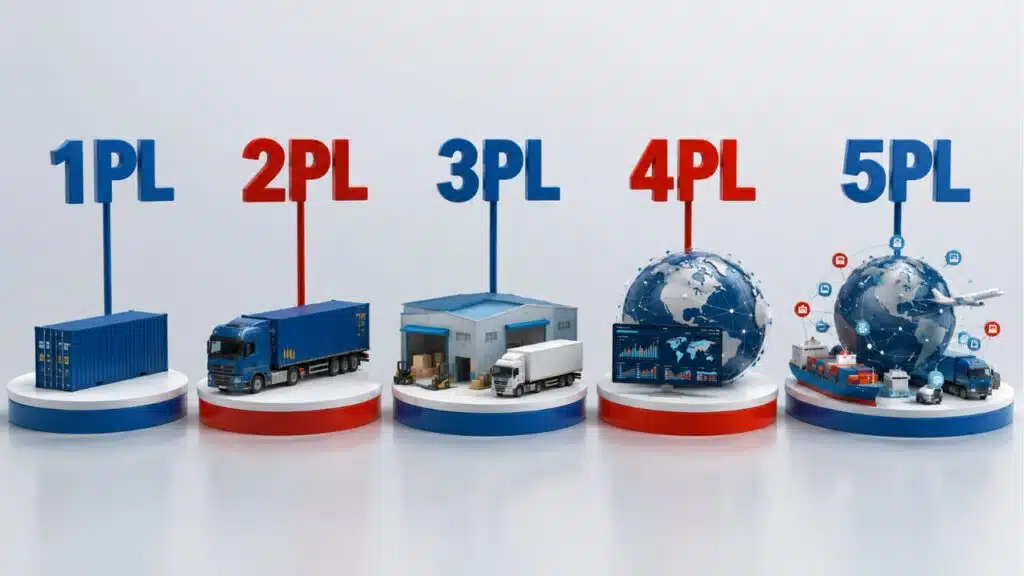
This is where the terms 1PL, 2PL, 3PL, 4PL, and 5PL come from. These five levels describe how much of the logistics work a business handles on its own versus how much it hands over to outside partners. In this guide, we explain each model in simple words, share real examples, and help you figure out which model fits your business today and as you grow.
Table of Contents
A logistics model is the system a business uses to plan, store, and move its goods from the factory to the final customer. This covers warehousing, packing, transport, customs paperwork, and order tracking.
As a business grows, its logistics needs grow too. A small shop might handle everything on its own. A large company shipping across borders usually needs outside help. This is why logistics is broken into five levels, from 1PL to 5PL, each one handing over more control to outside experts.
1PL means the business handles its own logistics from start to finish. There is no outside company involved. The business owns the vehicles, the storage space, and the staff who pack and ship orders.

Example: A local furniture maker that delivers its own products to nearby customers using its own truck and driver.
Good for: Very small businesses with a limited delivery area and low order volume.
Main limitation: It becomes hard to manage once order volume grows or the business wants to deliver further away, including international shipments.
2PL means the business hires an outside company for one specific part of logistics, usually transport. The business still manages storage, packing, and order processing on its own.

Example: A manufacturer that packs its own goods but hires a trucking or shipping line to move the cargo to its destination.
Good for: Growing businesses that need help with transport but still want control over storage and packing.
Main limitation: The business still has to manage warehousing, documentation, and other tasks, which takes time and resources.
3PL is one of the most widely used models among growing and mid sized businesses. Here, the business hires an outside logistics company to handle warehousing, packing, shipping, customs clearance, and sometimes returns. The business focuses on its core operations while the 3PL partner manages the rest.

Example: An import or export business that works with a freight and logistics partner to handle container shipping, customs clearance, and final delivery, instead of managing each step alone.
If your business needs this level of support, our logistics services team can manage warehousing, freight, and customs clearance on your behalf.
Good for: Trading companies, importers, exporters, and any business that wants to save time and reduce shipping errors.
Main limitation: The business has less direct, day to day control over how orders are handled.
4PL goes a step further than 3PL. Instead of just handling warehousing and shipping, a 4PL provider manages the entire supply chain strategy. This often includes coordinating multiple transport modes and 3PL partners, tracking performance, and improving the whole logistics process using data and planning tools.

Example: A large trading company that hires a 4PL partner to manage its sea freight, air freight, and road freight routes together, making sure every leg of the journey connects smoothly.
Good for: Large businesses with complex, multi country supply chains.
Main limitation: Higher cost, and it usually only makes sense once a business reaches a certain scale of shipping volume.
5PL is the newest and most advanced logistics model. A 5PL provider manages logistics networks for many different businesses at once, often using advanced technology such as AI and data analytics to plan the most efficient routes and systems across entire industries or regions.

Example: A logistics technology company that designs and manages shipping networks for several large importers and exporters at the same time, optimizing warehousing and delivery across all of them together.
Good for: Very large businesses, trading groups, or companies operating across many countries with complex logistics needs.
Main limitation: This model is usually too advanced and costly for small or mid sized businesses.
The biggest difference between these models is how much control the business keeps versus how much it hands over to outside partners.
As you move from 1PL to 5PL, the business gives up more day to day control but gains more time, efficiency, and access to expert resources.
| Model | Who Handles Logistics | Key Features | Best For |
|---|---|---|---|
| 1PL | The business itself | Full control, own staff and vehicles | Very small local businesses |
| 2PL | Business + one outside partner | Outsources transport only | Small businesses needing shipping help |
| 3PL | Outside logistics company | Warehousing, packing, shipping, customs clearance | Importers, exporters, growing trading businesses |
| 4PL | Supply chain manager partner | Oversees multiple freight modes and 3PL providers | Large businesses with complex, multi country needs |
| 5PL | Network level logistics partner | Uses AI and data to manage networks | Enterprise level and global businesses |
1PL
2PL
3PL
4PL
5PL
Ask yourself these simple questions before choosing a model:
Most small businesses start with 1PL or 2PL. As order volume and shipping distance grow, many move to 3PL because it offers a good balance of cost, control, and convenience, especially for businesses dealing with import, export, or international freight.
Large businesses with operations across many countries often move toward 4PL or 5PL to manage complex networks. If your business ships internationally or deals with customs clearance, container shipping, or multiple freight modes, working with an experienced 3PL or 4PL partner is usually the smarter choice over managing everything in house.
Logistics is not one size fits all. A small local business does not need the same setup as a company shipping containers across continents. Understanding the difference between 1PL, 2PL, 3PL, 4PL, and 5PL helps you choose a model that matches your current size while leaving room to grow.
If you are unsure which model fits your business, it often helps to start simple and move up as your shipping volume and delivery area grow. To learn more about how we support businesses with freight, customs clearance, and full logistics management, visit our homepage or explore our logistics services page.
Most small businesses start with 1PL or 2PL. As order volume grows, many move to 3PL for better efficiency.
A 3PL provider handles warehousing, packing, shipping, and customs clearance for one business. A 4PL provider manages and coordinates multiple 3PL partners and the entire supply chain strategy.
Yes, in most cases. 5PL involves managing logistics networks across multiple businesses using advanced technology, which usually only makes sense for very large or global companies.
You can switch gradually. Many businesses start by outsourcing transport through 2PL, then move to full outsourcing of warehousing, shipping, and customs through 3PL as they grow.
Most import and export businesses benefit from 3PL since it covers warehousing, freight, and customs clearance, letting the business focus on sourcing and sales instead of shipping logistics.
Speak with our team to find the best shipping solutions for your business.
+230 52583493
Air Waybill (AWB) vs Bill of Lading (B/L): Key Differences Explained An Air Waybill (AWB)…

Sea Freight Rates: 7 Ways to Keep Shipping Costs Down Sea freight is one of…
Let’s work together to simplify your logistics and ensure fast, secure, and timely delivery of your shipments.

Your Trusted Partner in End-to-End Supply Chain Management, Offering Expertise, Reliability, and On-Time Delivery Across the Globe.