


HS Codes: Why the Wrong Code…
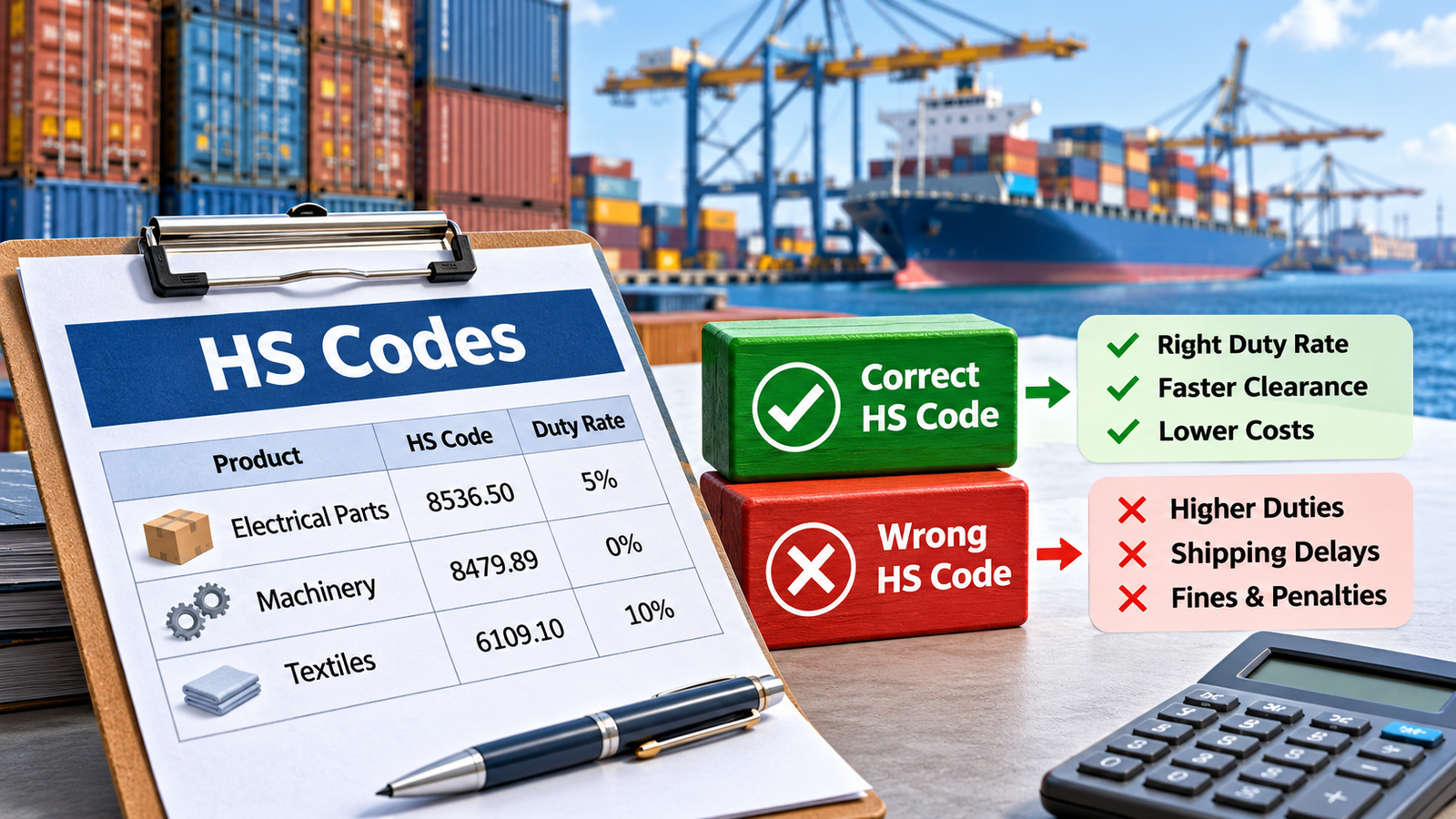
HS Codes: Why the Wrong Code Costs You Money When you import or export goods…

END TO END Solution
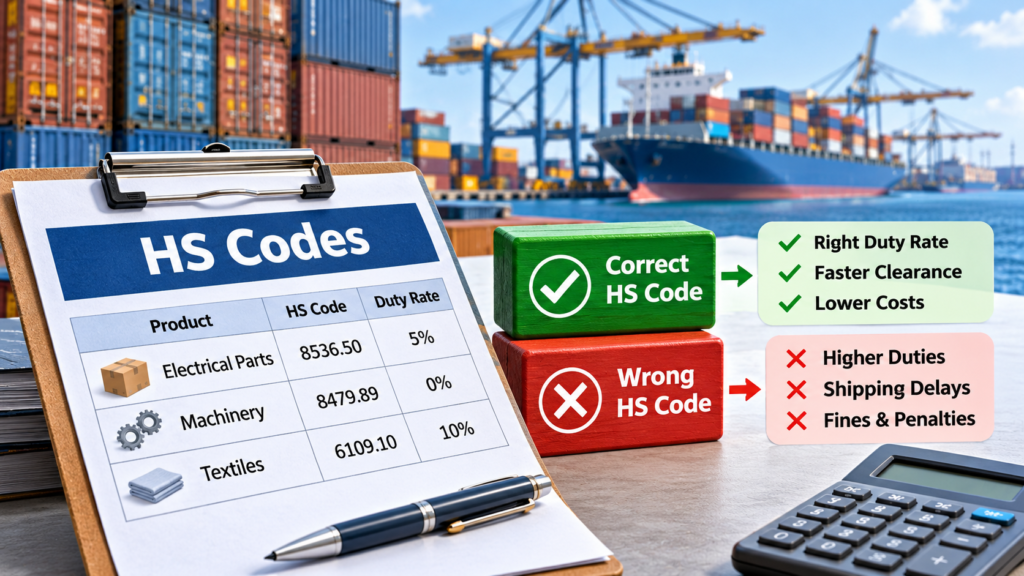
When you import or export goods internationally, every product must be correctly identified for customs purposes. One of the most important details in this process is the Harmonized System code, commonly known as the HS code.
HS Codes help customs authorities identify products, determine applicable duties and taxes, and establish whether specific import or export requirements apply. Even a small classification mistake can create unexpected costs, customs queries, shipment delays and compliance problems.
Imagine importing a shipment of electrical components and declaring the wrong HS code. The code may result in an incorrect duty calculation or cause customs authorities to request additional documents. Your cargo could remain on hold while the classification is reviewed, potentially creating storage charges and disrupting your delivery schedule.
Understanding HS Codes and checking them before shipping can help businesses avoid these problems. In this guide, we explain how HS Codes work, why incorrect classification costs money, and how importers and exporters can reduce the risk of errors.
Table of Contents
International shipping involves more than arranging transportation and preparing cargo for departure. Every product must be declared accurately, supported by the appropriate documentation and classified according to the customs rules of the countries involved.
HS Codes are an essential part of this process. They provide a standardized way to identify traded goods, but selecting the correct code requires more than finding a product name in an online search.
Products that appear similar may have different classifications because of their material, function, composition, technical specifications or intended use. A code that seems suitable at first may not be legally correct for the product being shipped.
That is why businesses should treat HS code classification as an important part of shipment planning, rather than something to complete at the last minute.
HS stands for Harmonized System. It is an internationally recognized system used to classify products traded across borders. The system was developed by the World Customs Organization (WCO) to create a common framework for describing and identifying goods in international trade.
Each product category is assigned a numerical code. Customs authorities use this classification to identify goods, assess applicable duties and taxes, apply trade measures and collect international trade statistics.
The international HS structure uses six-digit codes. Individual countries can extend these codes with additional digits to meet their national customs and statistical requirements.
For example, machinery, plastic products, textiles, food items and electronic equipment are classified under different headings and subheadings. The exact classification depends on the product’s characteristics and the applicable classification rules.
A six-digit HS code is generally structured as follows:
| Code Section | Digits | Meaning |
|---|---|---|
| Chapter | First 2 digits | Identifies the broad category of goods. |
| Heading | First 4 digits | Identifies a more specific product group. |
| Subheading | First 6 digits | Identifies the internationally harmonized product classification. |
For example, a code such as 8517.13 represents a classification within the broader telecommunications equipment category. This is only an illustration of the code structure; the correct classification for a particular product must be verified against the applicable tariff schedule.
Important: An HS code is not simply a product reference number. It is part of a formal customs classification system, and the correct classification must be supported by the product’s actual characteristics.
HS code classification follows a structured system. Customs authorities and traders use the product description, relevant section and chapter notes, heading descriptions and interpretation rules to identify the appropriate classification.
The process begins with understanding exactly what the product is. Its material, composition, function, manufacturing process and technical characteristics may all influence the classification.
The first six digits provide the internationally harmonized classification. However, the complete tariff code may be longer depending on the country.
| Code Level | Purpose | Where It Applies |
|---|---|---|
| 6-digit HS code | Internationally harmonized product classification | Common international HS framework |
| 8-digit tariff code | Additional product classification detail | Used by some national tariff systems |
| 10-digit or longer code | More detailed national classification | Used by certain countries |
Not every country uses the same number of digits beyond the international six-digit level. Importers should always verify the complete code required by the destination country’s customs authority.
Correct HS code classification affects several parts of an international shipment. It is not only about identifying a product or selecting a duty rate. It can also influence whether goods are subject to additional regulatory requirements.
Customs authorities use tariff classification together with factors such as customs value and country of origin to determine the applicable customs duties. If the declared code is incorrect, the duty calculation may also be incorrect.
Some products require specific licences, permits or regulatory approvals. The classification can help determine whether those requirements apply.
Correct classification helps businesses comply with customs rules, product restrictions and other applicable trade measures.
Accurate product descriptions and codes reduce the risk of unnecessary classification queries, document corrections and additional checks.
Importers need to estimate the full cost of bringing products into a country. Incorrect classification can affect duty estimates and make the actual landed cost higher than expected.
For businesses that regularly import or export products, classification accuracy should be part of their standard shipment documentation process.
Using an incorrect HS code can create financial consequences at different stages of international shipping. The actual impact depends on the destination country’s laws, the type of error, the applicable tariff and the circumstances of the shipment.
Here are seven ways incorrect HS code classification can cost your business money.
If the correct classification carries a higher duty rate than the code originally declared, customs authorities may reassess the shipment and request payment of the duty difference.
This can create an unexpected expense, especially when the business has already calculated its selling price using a lower estimated import duty.
Some customs administrations impose penalties for incorrect declarations, particularly when an importer fails to meet its legal obligations or does not correct a known classification error.
The amount and circumstances of any penalty vary by country. An honest classification disagreement does not automatically lead to the same consequences as deliberate misclassification.
If customs authorities identify a discrepancy between the declared HS code and the actual product, they may request additional information or carry out further checks.
While the issue is being resolved, the shipment may remain uncleared. This can affect delivery commitments, production schedules and customer orders.
A customs hold can prevent cargo from being released within the expected timeframe. Depending on the shipment and the terms of the carrier or terminal, additional charges may apply.
These charges are not automatically imposed whenever an HS code is incorrect. However, if a classification issue delays clearance or cargo movement, they can become part of the overall financial impact.
Read more about demurrage vs. detention and how to avoid extra charges.
An incorrect code may cause a business to overlook an applicable licence, certificate or regulatory approval. If customs authorities identify the requirement during clearance, the importer may need to arrange additional documentation.
This can create delays and additional administrative expenses. In some situations, goods may not be allowed to enter the country until the relevant requirements are met.
Some products may qualify for reduced or preferential duty treatment under applicable trade agreements or national tariff provisions. However, eligibility depends on several conditions, including correct classification, origin rules and supporting documentation.
Using the wrong code may result in an incorrect preference claim or prevent an eligible shipment from receiving the intended tariff treatment.
If the same incorrect code is reused for multiple shipments, the problem can extend beyond one declaration.
Repeated errors may lead to additional customs reviews, reassessments and corrective work. They can also make it more difficult to maintain accurate import records and cost forecasts.
| HS Code Problem | Possible Business Impact |
|---|---|
| Incorrect duty classification | Additional duty payment or excess duty paid |
| Incorrect declaration | Customs queries, reassessment or possible penalties |
| Missing regulatory approval | Additional paperwork and clearance delays |
| Customs inspection or review | Additional handling and operational costs |
| Delayed cargo release | Possible storage, demurrage or detention charges |
| Repeated classification errors | Ongoing compliance and administrative problems |
The key point is simple: a wrong HS code can affect more than customs duty. It can influence the entire cost and timeline of an international shipment.
Consider a business importing electrical components from China. The importer is preparing a shipment with an estimated customs value of $20,000.
During the documentation process, the product is assigned an HS code without checking its exact technical specifications. The selected code has a lower assumed duty rate than the classification customs authorities later determine to be correct.
For illustration, assume the following hypothetical rates:
| Details | Declared Classification | Correct Classification |
|---|---|---|
| Customs value | $20,000 | $20,000 |
| Illustrative duty rate | 5% | 10% |
| Customs duty | $1,000 | $2,000 |
Potential duty difference: $1,000.
This is a simplified illustration, not an actual tariff quotation. The rates are hypothetical and do not represent the duty applicable to a particular electrical component or destination country.
Even though the initial classification error may appear small, the financial impact can increase when additional charges and operational disruption are considered.
Many classification problems happen because businesses rely on incomplete product information or use codes without verifying the applicable customs rules.
A general product name may not provide enough information to identify the correct classification. Products with similar names can have different materials, functions or technical specifications.
How to avoid it: Review the complete product description, composition, intended use and technical details before selecting a code.
Importers sometimes reuse a code from a previous shipment because the product appears similar. However, the previous classification may have been incorrect, or the applicable tariff schedule may have changed.
How to avoid it: Recheck the code against the current tariff schedule and confirm that the product has not changed.
The international six-digit HS structure is harmonized, but national tariff extensions and additional requirements can differ.
How to avoid it: Verify the complete tariff code required by the country of import.
Material and composition can influence classification. For example, a finished product made primarily from plastic may not be classified in the same way as a similar product made from metal.
How to avoid it: Keep accurate material specifications and manufacturing details available.
Two products may be used for the same general purpose but may not belong to the same tariff classification. Their construction, function and technical characteristics may differ.
How to avoid it: Review the actual product characteristics and relevant classification rules rather than relying only on how the product is marketed.
Suppliers may provide HS codes on invoices or packing documents. However, the importer should not assume that the suggested code is automatically correct for the destination country’s tariff schedule.
How to avoid it: Treat supplier-provided codes as a starting point and independently verify the classification.
HS nomenclature is periodically updated, and countries may revise their national tariff schedules. A code that was valid for an earlier shipment may need to be reviewed when classification changes take effect.
How to avoid it: Review tariff updates and maintain a process for checking product codes periodically.
Finding the correct HS code requires a systematic approach. An online search can help identify possible classifications, but the final code should be verified using the official tariff resources and classification rules of the importing country.
Start with a detailed description of the goods. Avoid vague terms such as “machine parts”, “plastic items” or “electronic products”.
Instead, describe what the product is, what it does, what it is made from and how it is used.
Gather the information needed to distinguish the product from similar goods.
Use the relevant customs authority’s tariff database or official classification resources to identify possible headings and subheadings.
The WCO provides information about the Harmonized System, but it does not classify individual products for private businesses. The WCO advises traders to contact the relevant national customs administration for product-specific classification assistance.
Do not rely only on a matching product description. Review the relevant section notes, chapter notes, heading descriptions, subheading notes and applicable interpretation rules.
These provisions help determine which classification legally applies to the product.
After identifying the international six-digit HS code, verify the additional digits used by the destination country’s national tariff schedule.
Also check the associated duty rate, import conditions, restrictions and documentation requirements.
If the product is complex or could fit multiple headings, consult a qualified customs classification specialist or the relevant customs authority.
Some countries provide advance or binding tariff classification decisions under their own procedures. These can provide greater certainty when available and applicable.
Accurate HS code classification depends on the quality of the product information available. A short description on a commercial invoice may not be enough to classify a complex product correctly.
Importers and exporters should maintain supporting documents that clearly explain what is being shipped.
| Information or Document | Why It Is Useful |
|---|---|
| Commercial invoice | Provides the product description, quantity, value and seller/buyer details. |
| Product specification sheet | Explains technical characteristics and product functionality. |
| Product catalogue | Provides product details, model information and intended use. |
| Material composition | Identifies the materials used in manufacturing the product. |
| Product photographs | Help illustrate the product’s physical appearance and construction. |
| Technical drawings | May help explain complex machinery, components or equipment. |
| Previous classification records | Provide a reference for review, but should not replace current verification. |
Consider the difference between these descriptions:
The second description provides more useful information for classification review. It does not automatically establish the correct code, but it gives the reviewer a better understanding of the actual goods.
For related shipping documentation guidance, read our articles on commercial vs. proforma invoices and the export packing list.
HS codes and customs duties are closely connected, but they are not the same thing.
An HS code identifies how goods are classified for customs purposes. Customs duty is a tax or charge that may apply when goods are imported or exported, depending on the relevant country’s laws and tariff provisions.
| HS Code | Customs Duty |
|---|---|
| Identifies the product’s customs classification. | Represents the applicable duty payable under the tariff rules. |
| Uses an internationally harmonized six-digit base. | Rates are determined by national customs legislation and tariff schedules. |
| Helps identify applicable trade measures and requirements. | May be calculated using the product’s classification, customs value and origin. |
| Can be extended by individual countries. | Can vary according to product, origin, trade agreements and other applicable rules. |
Customs duty calculations commonly depend on several factors:
For example, two products with different classifications may attract different duty rates even when their declared values are similar. Likewise, the same classification may receive different tariff treatment depending on the country of origin and applicable trade agreements.
To understand another important part of customs assessment, read our guide on what an HS code is and our article on Incoterms rules.
The Harmonized System creates a common international classification framework, but it does not mean that every country uses an identical complete tariff code or applies the same duty rates.
The first six digits are harmonized internationally. Countries can add further digits to classify goods in greater detail for their own customs and statistical purposes.
A product may have the same six-digit HS classification in two countries, but the national tariff codes may contain additional digits.
| Country Tariff System | Classification Structure |
|---|---|
| International HS framework | Six-digit code |
| Country A | Eight-digit national code |
| Country B | Ten-digit national code |
This is a simplified illustration of how national extensions work. It does not represent the actual tariff code for a specific product in either country.
For businesses shipping internationally, checking the destination country’s tariff schedule before dispatch is an important step in avoiding unexpected customs issues.
Before confirming an international shipment, importers and exporters should review the HS code and related product information. A consistent verification process can help reduce classification errors and improve customs documentation accuracy.
The product description and other relevant details should be consistent across the documents submitted for customs clearance.
For example, if the commercial invoice describes a product as industrial electrical control equipment, the supporting technical documents should provide details that match that description.
Inconsistent descriptions can create questions during customs review, even when the intended product classification is correct.
Freight forwarders play an important role in coordinating international shipments. They help businesses manage transportation arrangements, shipping documentation and communication with relevant logistics partners.
While the importer or exporter remains responsible for meeting its applicable customs obligations, an experienced freight forwarder can help identify potential documentation issues before cargo is shipped.
A freight forwarder can review the commercial invoice, packing list and available product information to identify unclear descriptions or inconsistencies that may require attention.
Where a classification question arises, the freight forwarder can help coordinate with the customs broker, customs agent or classification specialist involved in the shipment.
Freight forwarders can help coordinate the documentation and communication required for customs clearance, including responding to requests for additional shipment information through the appropriate parties.
Reviewing shipping information before cargo dispatch can help identify missing details or possible compliance concerns early, reducing the risk of avoidable last-minute corrections.
Once the documentation and customs requirements are addressed, a freight forwarder can coordinate the appropriate transportation arrangements and cargo movement.
At Clevertactic, we support businesses with international logistics coordination, including sea freight, air freight, road freight and customs clearance services.
Our goal is to help businesses coordinate their shipments with better documentation preparation and reliable logistics support.
HS Codes are a critical part of international trade. They help customs authorities identify products, apply tariff provisions and determine whether additional import or export requirements apply.
Using the wrong HS code can result in additional duty payments, customs reassessments, possible penalties, shipment delays and unexpected logistics expenses. The exact consequences depend on the destination country’s customs laws and the circumstances of the classification error.
Businesses should never select an HS code based only on a product name, an old shipment record or a supplier’s suggestion. Instead, they should review the product’s technical specifications, check the relevant classification rules and verify the complete code against the importing country’s current tariff schedule.
A little extra attention before dispatch can help prevent costly problems during customs clearance.
If you need support coordinating your international shipments, contact Clevertactic to discuss your logistics requirements.
An HS code is a numerical classification used to identify products traded internationally. The Harmonized System was developed by the World Customs Organization and provides a standardized six-digit classification structure used as the basis for national tariff systems.
The internationally harmonized HS code contains six digits. Individual countries may extend it to eight, ten or more digits for their own customs and statistical requirements. The complete code depends on the importing country’s tariff schedule.
Using an incorrect HS code may result in customs reassessment, additional duty payments, document requests, shipment delays or penalties where applicable under national law. The actual consequences depend on the classification error and the country’s customs rules.
Yes. Products that look similar or serve similar purposes may have different HS codes because of differences in their material, composition, function, construction or technical characteristics.
Responsibility depends on the country’s customs laws, the import or export arrangement and the parties involved. Importers and exporters should ensure their declarations are accurate and should not assume that a supplier-provided or broker-entered code automatically removes their legal responsibilities.
The first six digits follow the international HS classification structure, but countries may use additional digits in their national tariff schedules. Always verify the complete code required by the destination country.
No. An incorrect classification does not automatically result in a penalty in every country or situation. Customs authorities may request clarification or reassess the declaration. Penalties and other consequences depend on the applicable national laws and circumstances, including whether the error is corrected when required.
Start by preparing a detailed product description and collecting technical specifications. Then review the official tariff classification resources and rules of the importing country. For complex products, seek advice from a qualified customs classification specialist or the relevant customs authority.
HS classification is one of the factors used to determine the applicable customs tariff. The final duty calculation may also depend on customs value, country of origin, trade agreements and other applicable national measures.
Yes. A freight forwarder can help review shipment documentation, identify unclear product descriptions and coordinate with customs brokers or classification specialists. However, the freight forwarder does not automatically determine or guarantee the legally correct classification for every product.
Speak with our team to find the best shipping solutions for your business.
+230 52583493
HS Codes: Why the Wrong Code Costs You Money When you import or export goods…

7 Hidden Shipping Charges Your Quote May Not Show International shipping involves more than choosing…
Export Packing List: 7 Details You Must Get Right International shipping involves more than booking…
Let’s work together to simplify your logistics and ensure fast, secure, and timely delivery of your shipments.

Your Trusted Partner in End-to-End Supply Chain Management, Offering Expertise, Reliability, and On-Time Delivery Across the Globe.