Inbound logistics and
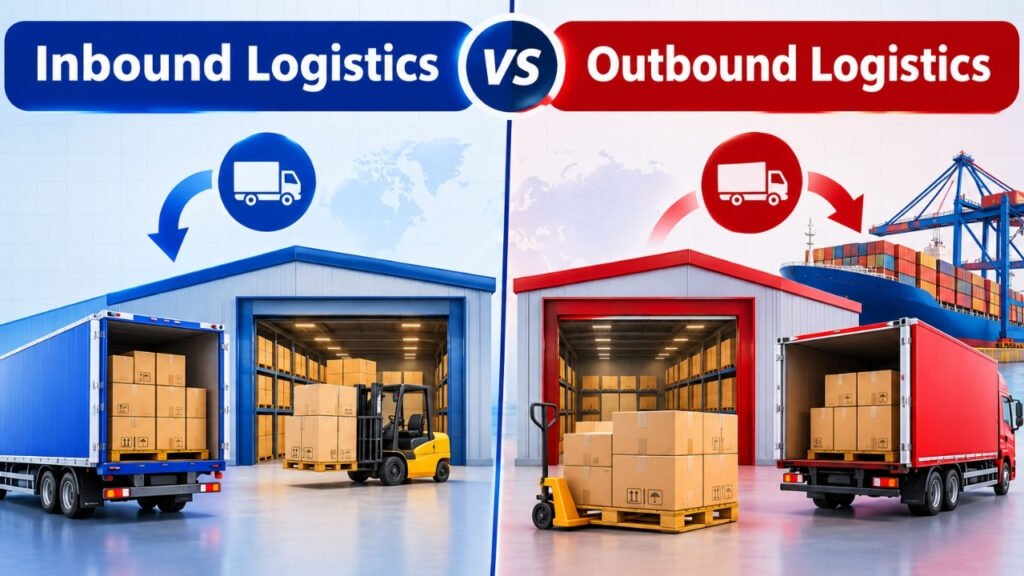
outbound logistics are two essential parts of the supply chain. Although both involve the movement and management of goods, they focus on different directions and business activities.
Inbound logistics generally covers the movement of raw materials, components, products, or supplies
into a business, while outbound logistics covers the movement of finished goods
from a business to customers or other destinations.
Understanding the difference between inbound and outbound logistics can help businesses improve inventory management, transportation planning, warehousing, order fulfillment, and customer service.
In this guide, we explain what inbound and outbound logistics mean, how they work, their key differences, common activities, challenges, examples, and how businesses can improve both processes.
Introduction
Every business that buys, stores, manufactures, sells, or distributes physical goods depends on logistics.
Logistics covers activities such as transportation, warehousing, inventory management, order processing, cargo handling, and delivery.
These activities can generally be divided into two important flows:
inbound logistics and
outbound logistics.
For businesses involved in international trade, understanding both flows is especially important because goods may move through factories, warehouses, ports, distribution centres, and customers across multiple countries.
Companies using
sea freight services may also need to coordinate inbound and outbound transportation with shipping lines, freight forwarders, customs brokers, terminals, and inland transport providers.
1. What Is Inbound Logistics?
Inbound logistics refers to the movement and management of goods, materials, components, or supplies coming
into a business or organization.
The process usually begins with a supplier and ends when the goods are received and stored or made available for production or other business activities.
Typical inbound logistics may include:
- Supplier coordination
- Purchase order management
- Transportation from suppliers
- Import coordination
- Customs clearance
- Receiving goods
- Unloading cargo
- Warehouse receiving
- Quality inspection
- Inventory storage
Simple Inbound Logistics Flow
Supplier → Transportation → Receiving Facility → Warehouse → Production or Inventory
For a manufacturer, inbound logistics may involve bringing raw materials into a factory. For a retailer, it may involve receiving finished products from suppliers or distribution centres.
2. How Does Inbound Logistics Work?
A typical inbound logistics process may follow these steps:
- The business identifies its material or inventory requirements.
- A purchase order is placed with a supplier.
- The supplier prepares the goods.
- Transportation is arranged.
- The shipment moves toward the receiving location.
- Customs clearance is completed where applicable.
- The goods arrive at the warehouse or facility.
- The cargo is unloaded and inspected.
- The goods are recorded in the inventory system.
- The goods are stored or transferred to production.
Effective inbound logistics helps ensure that the right materials arrive at the right location at the right time.
3. What Is Outbound Logistics?
Outbound logistics refers to the movement and management of finished goods
from a business to customers, retailers, distributors, or other destinations.
Outbound logistics generally begins after products are manufactured or made available for sale.
Typical outbound logistics activities include:
- Order processing
- Inventory allocation
- Picking and packing
- Warehouse operations
- Shipment preparation
- Transportation planning
- Export documentation
- Order dispatch
- Customer delivery
- Delivery tracking
Simple Outbound Logistics Flow
Warehouse → Picking & Packing → Transportation → Distribution → Customer
For international shipments, outbound logistics may also include export customs procedures, port transportation, ocean freight, destination delivery, and coordination with logistics partners.
4. How Does Outbound Logistics Work?
A typical outbound logistics process may involve:
- A customer places an order.
- The business confirms inventory availability.
- The order is processed.
- Products are picked from inventory.
- Products are packed and labelled.
- Transportation is arranged.
- Required export or shipping documentation is prepared.
- The shipment leaves the warehouse.
- The goods move through the distribution network.
- The customer receives the shipment.
The objective is to deliver the correct product to the correct customer at the required time and in suitable condition.
5. Inbound vs Outbound Logistics: Key Differences
| Feature |
Inbound Logistics |
Outbound Logistics |
| Direction |
Goods move into the business. |
Goods move out of the business. |
| Main purpose |
Receive materials, supplies, or products. |
Deliver finished products to customers or distribution points. |
| Typical starting point |
Supplier or origin location. |
Warehouse, factory, or distribution centre. |
| Typical destination |
Factory, warehouse, or business facility. |
Customer, retailer, distributor, or final destination. |
| Common cargo |
Raw materials, components, supplies, and purchased goods. |
Finished goods and customer orders. |
| Key activities |
Purchasing, receiving, inspection, storage, and inventory replenishment. |
Order processing, picking, packing, dispatch, and delivery. |
| Primary focus |
Supply availability and production support. |
Customer fulfillment and delivery performance. |
| Key stakeholders |
Suppliers, carriers, customs brokers, warehouses, and receiving teams. |
Customers, distributors, retailers, carriers, and delivery partners. |
6. Common Inbound and Outbound Logistics Activities
Inbound Logistics Activities
- Supplier management
- Purchase order coordination
- Freight booking
- Import documentation
- Customs clearance
- Transportation scheduling
- Receiving and unloading
- Quality inspection
- Inventory receiving
- Warehouse storage
Outbound Logistics Activities
- Customer order management
- Inventory allocation
- Picking
- Packing
- Labelling
- Export documentation
- Freight booking
- Shipment dispatch
- Delivery tracking
- Final-mile delivery
7. Why Are Inbound and Outbound Logistics Important?
Better Inventory Management
Efficient inbound logistics helps businesses maintain the materials and products they need without unnecessarily increasing inventory levels.
Improved Production Planning
Manufacturers depend on reliable inbound deliveries to ensure raw materials and components are available when required.
Faster Customer Fulfillment
Efficient outbound logistics helps businesses process and deliver customer orders more effectively.
Lower Transportation Costs
Better shipment planning, consolidation, route selection, and carrier management can help control logistics costs.
Improved Customer Service
Reliable delivery performance can improve customer satisfaction and reduce complaints caused by late or incorrect shipments.
Better Supply Chain Visibility
Tracking inbound and outbound shipments provides businesses with better visibility into inventory movement and transportation performance.
8. Inbound Logistics Challenges
Supplier Delays
Late supplier shipments can affect production schedules and inventory availability.
Unpredictable Transportation
Port congestion, weather, capacity limitations, and other transportation issues can delay inbound cargo.
Customs Delays
International imports may be delayed because of incomplete documentation, inspections, classification issues, or other customs requirements.
Inventory Imbalances
Receiving too much or too little inventory can create additional storage costs or stock shortages.
Limited Visibility
Businesses may struggle to track shipments when suppliers and transportation providers use different systems.
9. Outbound Logistics Challenges
Order Delays
Warehouse or transportation problems can delay customer orders.
Incorrect Shipments
Picking and packing errors can result in customers receiving the wrong products or quantities.
Transportation Costs
Fuel prices, carrier rates, delivery distance, shipment size, and service requirements can affect outbound transportation costs.
Last-Mile Delivery
The final stage of delivery can be complex, particularly when customers are located across different regions or countries.
Returns
Businesses may also need reverse logistics processes to manage returned, damaged, or unwanted products.
10. How to Improve Inbound and Outbound Logistics
Improve Supplier Coordination
Maintain clear communication with suppliers regarding production schedules, shipment dates, quantities, and documentation.
Use Shipment Tracking
Tracking systems can provide better visibility into cargo movement and help businesses respond to delays.
Optimize Inventory Levels
Use demand forecasts and inventory data to reduce unnecessary stock while maintaining sufficient supply.
Consolidate Shipments
Where practical, combining compatible shipments can improve transportation efficiency and reduce costs.
Improve Warehouse Processes
Efficient receiving, storage, picking, packing, and dispatch processes can improve the overall logistics flow.
Work With Reliable Logistics Partners
Freight forwarders, customs brokers, carriers, and transport providers can play an important role in international logistics operations.
Measure Performance
Use logistics performance metrics to identify delays, errors, unnecessary costs, and opportunities for improvement.
11. Inbound vs Outbound Logistics Examples
Example 1: Manufacturing Company
A manufacturer imports steel, electronic components, and other raw materials from overseas suppliers.
The transportation of these materials from suppliers to the manufacturer’s warehouse or factory is part of
inbound logistics.
After manufacturing is complete, the finished products are shipped to distributors and customers. This movement is part of
outbound logistics.
Example 2: Retail Business
A retailer receives products from multiple suppliers at its distribution centre.
The movement from suppliers to the distribution centre is inbound logistics.
When customer orders are processed and products are shipped from the distribution centre to stores or customers, the process becomes outbound logistics.
Example 3: International Export
A company receives packaging materials from an overseas supplier. The materials are transported through the port and delivered to the company’s facility.
This is inbound logistics.
The company later exports its finished products to an overseas customer. The transportation from the company’s warehouse through the export process and onward to the customer is part of outbound logistics.
12. Key Logistics Performance Metrics
Businesses can use different performance indicators to measure inbound and outbound logistics.
| Metric |
What It Measures |
| On-time delivery |
Whether shipments arrive within the expected delivery window. |
| Order accuracy |
Whether customers receive the correct products and quantities. |
| Transit time |
Time required to move cargo between origin and destination. |
| Inventory accuracy |
How closely recorded inventory matches physical inventory. |
| Transportation cost |
Cost associated with moving goods. |
| Damage rate |
Percentage of shipments or products damaged during handling or transportation. |
| Order cycle time |
Time from receiving an order to completing delivery. |
| Warehouse processing time |
Time required to receive, process, pick, pack, or dispatch goods. |
13. Logistics Management Checklist
Businesses can review the following areas when evaluating inbound and outbound logistics:
- Supplier reliability
- Inventory requirements
- Transportation capacity
- Warehouse capacity
- Customs requirements
- Freight costs
- Shipment tracking
- Order accuracy
- Delivery performance
- Cargo handling procedures
- Packaging requirements
- Customer delivery requirements
- Returns and reverse logistics
Conclusion
The main difference between
inbound and outbound logistics is the direction and purpose of the movement.
Inbound logistics manages the flow of materials, supplies, components, or products into a business. It focuses on supplier coordination, transportation, receiving, customs clearance, inventory, and production or warehouse availability.
Outbound logistics manages the movement of finished goods from a business to customers, retailers, distributors, or other destinations. It focuses on order processing, picking, packing, transportation, dispatch, and delivery.
Both are essential to an efficient supply chain. Improving visibility, inventory management, warehouse operations, transportation planning, and coordination with logistics partners can help businesses reduce costs and improve service.
Businesses involved in international trade can also review
freight forwarding services to understand how transportation, customs, documentation, and cargo movement can be coordinated across the supply chain.
Frequently Asked Questions
1. What is inbound logistics?
Inbound logistics is the process of managing the movement of materials, supplies, components, or products into a business, warehouse, or manufacturing facility.
2. What is outbound logistics?
Outbound logistics is the process of managing the movement of finished products from a business or warehouse to customers, retailers, distributors, or other destinations.
3. What is the main difference between inbound and outbound logistics?
Inbound logistics focuses on goods coming into a business, while outbound logistics focuses on finished goods moving out of the business toward customers or distribution points.
4. Is transportation part of inbound and outbound logistics?
Yes. Transportation is an important part of both inbound and outbound logistics. The difference is the direction and purpose of the shipment.
5. Is customs clearance part of inbound logistics?
For international imports, customs clearance can be an important part of inbound logistics. Export customs procedures can similarly form part of outbound logistics.
6. What is an example of inbound logistics?
A manufacturer receiving raw materials from an overseas supplier is an example of inbound logistics.
7. What is an example of outbound logistics?
A manufacturer shipping finished products from its warehouse to an overseas customer is an example of outbound logistics.
8. Why are inbound and outbound logistics important?
Efficient inbound and outbound logistics can help businesses maintain inventory, support production, control transportation costs, fulfill customer orders, and improve supply chain performance.