
Ocean Freight Charges Explained: A Complete…
Ocean Freight Charges Explained: A Complete Guide to Shipping Costs Ocean freight charges are one…
END TO END Solution
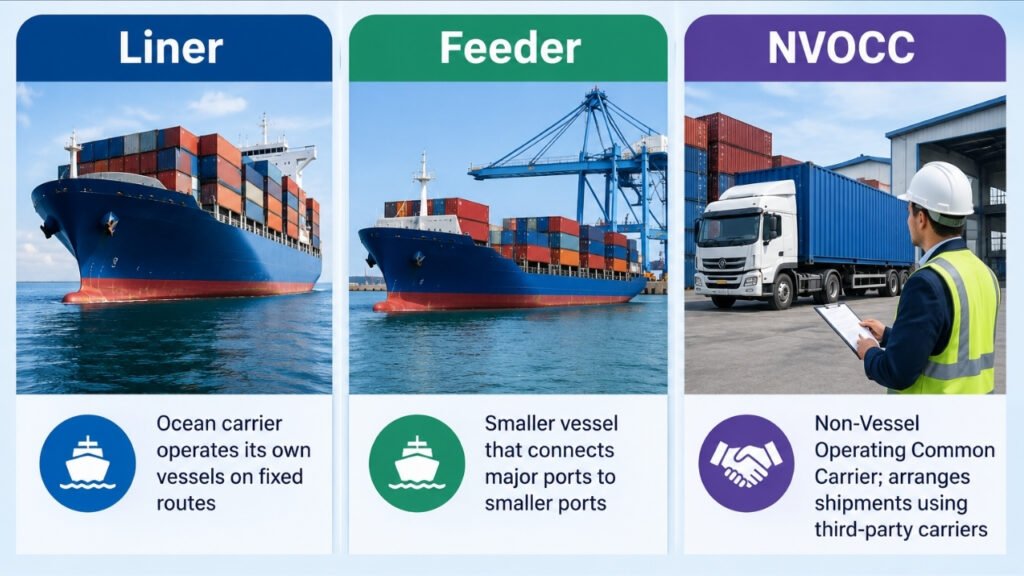
When a container moves through international shipping, several different companies may be involved before it reaches its final destination.
A liner, feeder operator, and NVOCC can all play different roles in moving cargo through the global supply chain. Understanding these roles helps exporters and importers know who operates the vessel, who connects smaller ports with major hubs, and who arranges ocean transportation without operating its own vessels.
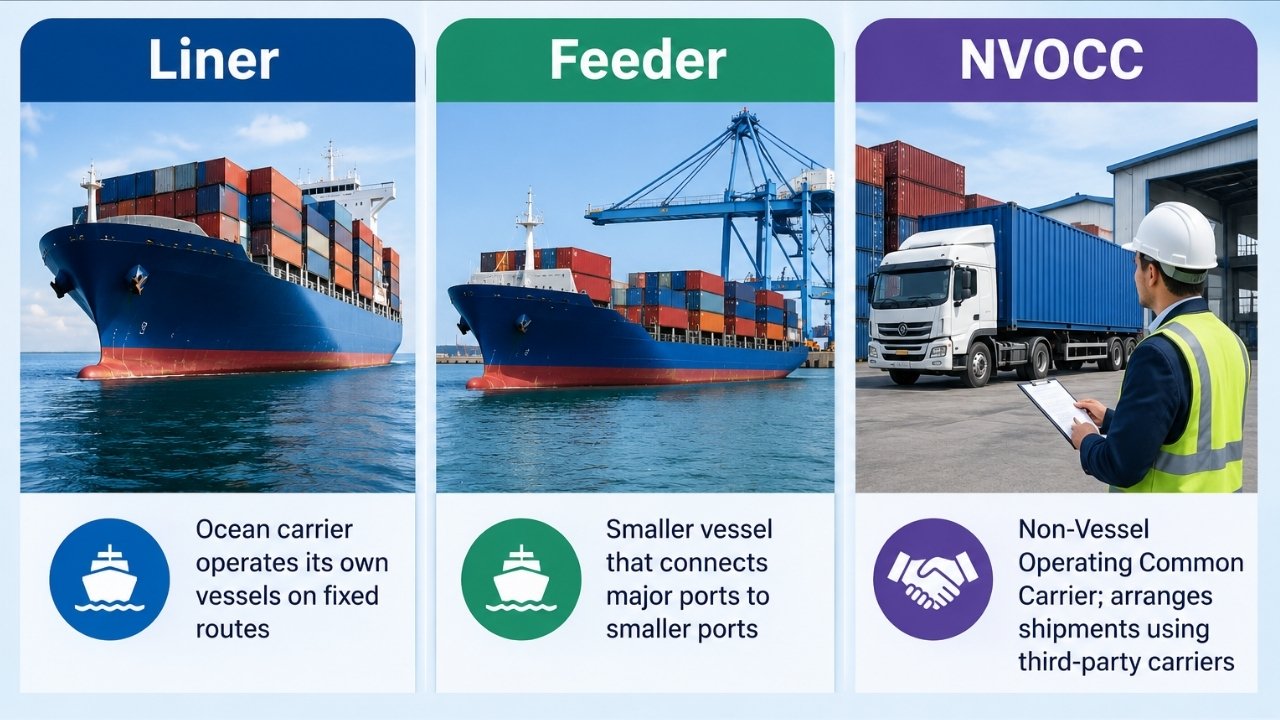
In simple terms, a liner generally operates scheduled ocean services, a feeder connects smaller or regional ports with major hub ports, and an NVOCC buys or arranges ocean freight capacity and sells transportation services to customers without operating the vessel as a traditional ocean carrier.
In this guide, we explain what liners, feeder operators, and NVOCCs are, how they work together, their differences, and how exporters and importers can determine which shipping partner is involved in their cargo movement.
Table of Contents
International container shipping often involves more than one transportation provider.
A container may begin its journey at a small regional port, move by feeder vessel to a major transshipment hub, and then continue on a large mainline vessel to another continent.
At the same time, the exporter may book the shipment through a freight forwarder or NVOCC rather than directly with the ocean carrier.
This creates several layers within the shipping process.
For businesses using sea freight services, understanding these roles can make it easier to follow shipment schedules, bills of lading, transshipment arrangements, and carrier responsibilities.
A liner shipping company, commonly called an ocean carrier or container liner, operates scheduled maritime services between ports.
Liner services normally operate according to published routes and schedules, carrying cargo for multiple customers on the same vessel.
Examples of liner activities include:
A liner may operate a large network connecting major ports around the world.
Origin Port → Mainline Vessel → Destination Port
However, many international services involve transshipment and feeder connections rather than a single direct vessel journey.
A typical liner shipment may follow these steps:
The exact process depends on the carrier, trade route, port, and service arrangement.
A feeder vessel is generally a smaller container vessel used to connect regional or smaller ports with larger hub ports.
A feeder operator operates these services or vessels.
Instead of operating only a long-distance mainline service, feeder networks help connect ports that may not be directly served by large ocean-going vessels.
Smaller Port → Feeder Vessel → Hub Port → Mainline Vessel
Alternatively, the movement may happen in the opposite direction:
Mainline Vessel → Hub Port → Feeder Vessel → Regional Port
Feeder services are therefore an important part of many container shipping networks.
Consider an exporter located near a regional port that does not have a direct mainline service to the required overseas destination.
The container may first be loaded onto a feeder vessel.
The feeder vessel carries the container to a major transshipment hub, where the container is transferred to a larger mainline vessel.
The mainline vessel then transports the container toward the destination region.
Exporter → Regional Port → Feeder Vessel → Hub Port → Mainline Vessel → Destination Port
This arrangement allows shipping networks to connect a much larger number of ports without requiring every mainline vessel to call at every port.
NVOCC stands for Non-Vessel Operating Common Carrier.
An NVOCC provides ocean transportation services but does not operate ocean-going vessels in the same way as a traditional vessel-operating carrier.
An NVOCC may purchase or arrange cargo space from vessel-operating carriers and then sell transportation services to its own customers.
Depending on the jurisdiction and applicable rules, an NVOCC may perform carrier-like functions, including issuing its own bill of lading and establishing contractual arrangements with shippers.
Exporter → NVOCC → Ocean Carrier → Destination → Consignee
The NVOCC acts as an intermediary and contractual transportation provider between the shipper and vessel-operating carrier.
A typical NVOCC shipment may involve:
The exact responsibilities depend on the NVOCC’s business model, contractual terms, jurisdiction, and shipment arrangement.
| Feature | Liner | Feeder | NVOCC |
|---|---|---|---|
| Primary role | Operates scheduled ocean services. | Connects regional ports with hub ports. | Provides ocean transportation services without operating vessels as a traditional carrier. |
| Owns/operates vessels | Generally operates vessels or controls vessel capacity. | Operates feeder vessels or feeder services. | Does not operate vessels as its core operating model. |
| Typical vessel | Mainline container vessel. | Smaller feeder container vessel. | Uses vessel capacity purchased or arranged from carriers. |
| Main function | Long-distance scheduled container transportation. | Regional and hub connectivity. | Contractual and commercial ocean transportation service. |
| Customer | Shippers, freight forwarders, and other logistics providers. | Carriers or customers depending on the service. | Shippers and logistics customers. |
| Bill of lading | May issue its own carrier bill of lading. | Depends on the contractual arrangement. | May issue its own house or NVOCC bill of lading, depending on the jurisdiction and arrangement. |
These three roles are not necessarily competitors. They can operate together within the same shipment.
For example, an exporter may book cargo with an NVOCC.
The NVOCC arranges space with a vessel-operating carrier.
The container is then transported from a regional port to a major hub using a feeder vessel. At the hub, it is transferred to a mainline vessel for the international ocean leg.
Exporter → NVOCC → Feeder Service → Transshipment Hub → Mainline Liner → Destination Port → Consignee
This demonstrates why the company shown on a freight quotation may not always be the company physically operating the vessel carrying the cargo.
The bill of lading arrangement depends on how the shipment is booked.
In a direct carrier booking, the vessel-operating carrier may issue the carrier bill of lading to the shipper.
When an NVOCC is involved, the NVOCC may issue its own house or NVOCC bill of lading to the shipper, while the vessel-operating carrier issues a master bill of lading to the NVOCC or contracting party.
| Document | Typical Parties |
|---|---|
| House Bill of Lading | May be issued by an NVOCC or freight forwarder to the shipper. |
| Master Bill of Lading | Generally issued by the vessel-operating carrier to the contracting transportation provider. |
The exact document structure varies depending on the parties, trade route, and contractual arrangement.
An NVOCC may have access to capacity from multiple vessel-operating carriers, allowing customers to compare different routes and schedules.
NVOCCs can consolidate cargo from multiple customers and arrange transportation efficiently.
Depending on the provider, customers may receive different service options based on routing, transit time, equipment, and pricing.
An experienced NVOCC or freight forwarder may understand specific trade lanes and provide guidance on routing and documentation.
Working through an intermediary can provide access to carrier capacity without requiring the shipper to negotiate separately with multiple ocean carriers.
When choosing between a direct carrier, NVOCC, or freight forwarding provider, consider:
The cheapest rate is not necessarily the best option. A slightly higher rate may provide a better sailing schedule, fewer transshipments, stronger destination support, or more reliable service.
Imagine an exporter has one container of general cargo that needs to move from a smaller regional port to an overseas destination.
The exporter books the shipment with an NVOCC or freight forwarder.
The loaded container arrives at the regional port.
The container is loaded onto a feeder vessel and transported to a major transshipment hub.
At the hub, the container is discharged from the feeder vessel and transferred to a mainline vessel.
The mainline vessel carries the container toward the destination region.
The container arrives at the destination port and proceeds through the applicable import and delivery process.
The complete movement may look like:
Exporter → Regional Port → Feeder → Hub → Mainline Liner → Destination Port → Importer
The NVOCC may coordinate the contractual transportation arrangement throughout the shipment.
Before selecting a carrier, feeder operator, NVOCC, or freight forwarding partner, consider:
Liners, feeder operators, and NVOCCs perform different but interconnected roles in container shipping.
A liner generally operates scheduled mainline ocean services. A feeder operator connects smaller or regional ports with major hub ports. An NVOCC provides ocean transportation services without operating vessels as a traditional vessel-operating carrier.
A single container can involve all three. An NVOCC may arrange the shipment, a feeder vessel may move the container to a hub, and a mainline liner may carry it across the ocean to the destination region.
Understanding these roles can help exporters and importers evaluate freight quotations, understand bills of lading, follow transshipment routes, and choose suitable shipping services.
Businesses involved in international cargo movement can also review freight forwarding services to understand how ocean transportation, documentation, customs coordination, and inland logistics can be managed.
A liner is generally an ocean carrier that operates scheduled maritime services between ports and provides container transportation capacity.
A feeder vessel is generally a smaller container vessel used to connect regional or smaller ports with major hub ports.
NVOCC stands for Non-Vessel Operating Common Carrier.
An NVOCC does not operate ocean-going vessels as a traditional vessel-operating carrier. It generally arranges or purchases vessel capacity from ocean carriers and sells transportation services to customers.
A liner generally operates scheduled vessel services, while an NVOCC provides ocean transportation services without operating vessels as a traditional carrier.
Feeder vessels connect smaller or regional ports with major hub ports, allowing cargo to connect with larger mainline ocean services.
Yes. A container may travel on a feeder vessel to a transshipment hub and then be transferred to a mainline vessel for the longer ocean journey.
An NVOCC may issue its own house or NVOCC bill of lading, while the vessel-operating carrier may issue a master bill of lading. The exact arrangement depends on the shipment and contractual structure.
No. The roles can overlap, but they are not automatically the same. An NVOCC acts as a transportation intermediary or carrier under applicable regulations and may issue its own bill of lading, while a freight forwarder’s role can vary depending on its services and jurisdiction.
There is no single best option. The right choice depends on freight rates, service frequency, transit time, routing, equipment availability, documentation, destination support, and the specific requirements of the shipment.
Speak with our team to find the best shipping solutions for your business.
+230 52583493

Ocean Freight Charges Explained: A Complete Guide to Shipping Costs Ocean freight charges are one…
How to Read a Shipping Container Number: A Simple Guide A shipping container number is…
Liner, Feeder and NVOCC Explained: Who Really Moves Your Cargo? When a container moves through…
Let’s work together to simplify your logistics and ensure fast, secure, and timely delivery of your shipments.

Your Trusted Partner in End-to-End Supply Chain Management, Offering Expertise, Reliability, and On-Time Delivery Across the Globe.