
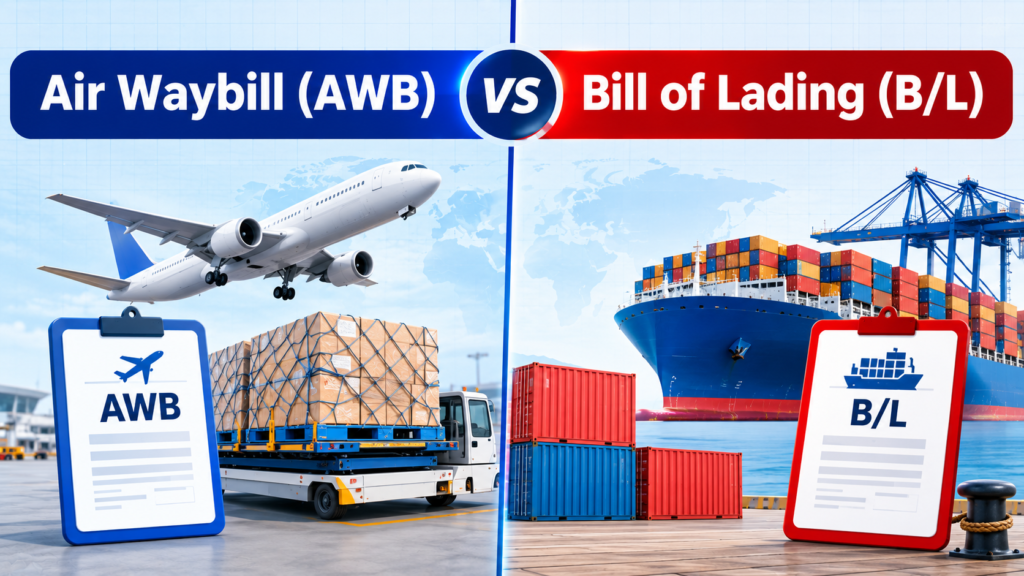


Air Waybill (AWB) vs Bill of…
Air Waybill (AWB) vs Bill of Lading (B/L): Key Differences Explained An Air Waybill (AWB)…

END TO END Solution

Accurately calculating shipment volume is an important part of international freight planning. Whether you are shipping cartons, pallets, or LCL cargo, knowing the total volume of your goods helps you understand how much space your shipment requires.
CBM, or Cubic Meter, is one of the most commonly used measurements in international shipping. Freight forwarders and carriers use CBM to determine cargo volume, particularly for sea freight and LCL shipments.
The good news is that how to calculate CBM is straightforward when you have the correct dimensions and quantity. This guide explains the CBM formula step by step and provides practical examples for different types of shipments.
Table of Contents
CBM stands for Cubic Meter, a measurement used to calculate the three-dimensional volume of cargo.
In international logistics, CBM helps determine how much physical space your shipment occupies inside a container, warehouse, truck, or other transportation equipment.
For example, if a carton measures:
You first convert the dimensions to meters:
Then:
0.60 × 0.40 × 0.50 = 0.12 CBM
Therefore, the carton occupies 0.12 cubic meters.
CBM is important because shipping companies need to understand the amount of space your cargo will occupy.
CBM can help with:
For smaller shipments that do not require a full container, accurate CBM information is particularly useful when requesting an LCL freight quote from a freight forwarding service.

The standard formula is:
CBM = Length × Width × Height × Quantity
When dimensions are provided in centimeters, convert them to meters first.
Suppose you have 5 boxes measuring:
50 cm × 40 cm × 30 cm
Convert to meters:
0.50 m × 0.40 m × 0.30 m
CBM for one box:
0.50 × 0.40 × 0.30 = 0.06 CBM
For 5 boxes:
0.06 × 5 = 0.30 CBM
So, the total shipment volume is 0.30 CBM.
If your supplier provides dimensions in centimeters, divide each measurement by 100.
| Centimeters | Meters |
|---|---|
| 10 cm | 0.10 m |
| 25 cm | 0.25 m |
| 50 cm | 0.50 m |
| 75 cm | 0.75 m |
| 100 cm | 1.00 m |
| 150 cm | 1.50 m |
| 200 cm | 2.00 m |
For example:
80 cm ÷ 100 = 0.80 m
Always convert all three dimensions before applying the CBM formula.
Suppose you have one carton with these dimensions:
60 cm = 0.60 m
40 cm = 0.40 m
50 cm = 0.50 m
0.60 × 0.40 × 0.50 = 0.12 CBM
Total volume = 0.12 CBM
This is the simplest example of how to calculate CBM for a shipment.
Now assume you have 10 identical cartons.
Each carton measures:
0.50 m × 0.40 m × 0.30 m
0.50 × 0.40 × 0.30 = 0.06 CBM
0.06 × 10 = 0.60 CBM
Your 10 cartons have a total volume of:
0.60 CBM
This method is useful when a shipment contains several cartons with exactly the same dimensions.
Shipments do not always contain identical cartons. Consider the following shipment:
| Carton | Dimensions | Quantity | CBM |
|---|---|---|---|
| A | 60 × 40 × 50 cm | 2 | 0.24 |
| B | 80 × 50 × 40 cm | 3 | 0.48 |
| C | 100 × 60 × 50 cm | 1 | 0.30 |
Carton A:
0.60 × 0.40 × 0.50 × 2 = 0.24 CBM
Carton B:
0.80 × 0.50 × 0.40 × 3 = 0.48 CBM
Carton C:
1.00 × 0.60 × 0.50 × 1 = 0.30 CBM
0.24 + 0.48 + 0.30 = 1.02 CBM
The total shipment volume is:
1.02 CBM
This approach is especially useful for mixed-carton shipments.
Palletized cargo can also be calculated using CBM.
Suppose a loaded pallet measures:
Convert to meters:
Apply the formula:
1.20 × 1.00 × 1.50 = 1.80 CBM
The pallet occupies approximately:
1.80 CBM
When calculating pallet volume, measure the full loaded dimensions, including the pallet and cargo where applicable.
LCL, or Less than Container Load, is commonly used when a shipment does not require a full container.
Imagine an LCL shipment containing:
0.60 × 0.40 × 0.50 × 4
= 0.48 CBM
0.80 × 0.50 × 0.40 × 3
= 0.48 CBM
1.00 × 0.60 × 0.50 × 2
= 0.60 CBM
0.48 + 0.48 + 0.60
= 1.56 CBM
Therefore, the total shipment volume is 1.56 CBM.
Accurate CBM information helps freight forwarders prepare more precise LCL quotations and cargo planning.
For businesses comparing LCL with full-container shipping, see our guide on FCL vs LCL shipping.
CBM is also related to volume calculations in air freight, but air cargo pricing generally considers chargeable weight, which may be based on either actual weight or volumetric weight.
Volumetric weight converts cargo volume into a weight equivalent using a carrier or service-specific dimensional factor.
A simplified calculation can be represented as:
Volumetric Weight = Length × Width × Height ÷ Applicable Divisor
The applicable divisor can vary depending on the airline, carrier, route, and service. Therefore, shippers should confirm the current dimensional factor with their freight provider.
A shipment may be lightweight but occupy significant space. In such cases, its volumetric weight may be higher than its actual weight and may affect the freight charge.
Businesses shipping time-sensitive cargo can also review available air freight services when comparing transportation options.
Even a simple CBM calculation can produce incorrect results if dimensions are entered incorrectly.
Using 60 × 40 × 50 directly instead of:
0.60 × 0.40 × 0.50
can produce a dramatically incorrect result.
If you have 20 identical cartons, calculate the CBM of one carton and multiply it by 20.
For shipping calculations, use the dimensions of the packed cargo, not just the product itself.
Do not combine centimeters, inches, and meters in the same calculation.
Unusual shapes, oversized packaging, pallets, and protective materials can affect the actual space required.
Keep sufficient decimal places during calculations and round the final result according to the freight provider’s requirements.
CBM can influence freight costs because it represents the physical space required by cargo.
The impact depends on the transportation mode and pricing structure.
CBM is commonly important when calculating the shipment’s volume and applicable freight charges.
The focus is generally on the container rather than simply charging each shipment by CBM. However, CBM remains useful for determining whether cargo can fit into a particular container.
Cargo volume can affect volumetric weight and therefore chargeable weight.
Cargo dimensions can help determine vehicle capacity and space utilization.
For businesses comparing transportation modes, sea freight services can be considered when shipment volume, transit time, and cost requirements make ocean transportation suitable.
CBM and chargeable weight are related but are not the same measurement.
| Measurement | What It Measures | Common Use |
|---|---|---|
| CBM | Cargo volume | Sea freight, LCL, space planning |
| Actual Weight | Physical cargo weight | Freight calculations |
| Volumetric Weight | Space converted into weight | Air freight |
| Chargeable Weight | Weight used for billing | Mainly air freight |
A shipment can have a high CBM but a low actual weight, or a low CBM but a high actual weight.
The applicable freight calculation depends on the transportation mode and carrier’s pricing rules.
Before sending your shipment details to a freight forwarder, confirm:
Having accurate dimensions and weight can make freight quotations more reliable.
Knowing how to calculate CBM is an essential skill for businesses involved in international shipping. The basic formula is simple:
CBM = Length × Width × Height × Quantity
The key is to use accurate packed dimensions, convert measurements into meters, and account for every carton or pallet in the shipment.
Whether you are shipping one carton, multiple boxes, pallets, or an LCL shipment, calculating CBM correctly helps you understand cargo volume and communicate accurate shipment information to your freight forwarder.
For international shipments, CBM should be considered alongside actual weight, transportation mode, destination, and carrier pricing rules when estimating total freight requirements.
Businesses that need help managing international shipments can also learn more about freight forwarding services and how professional freight management can support efficient cargo movement.
The basic CBM formula is Length × Width × Height × Quantity, with all dimensions converted to meters before calculation.
Convert each dimension from centimeters to meters by dividing by 100. Then multiply length × width × height and multiply by the number of packages.
One CBM represents one cubic meter of cargo volume. It does not represent a fixed weight because different products have different densities.
CBM helps determine the volume of cargo in an LCL shipment and can be an important factor in calculating applicable freight charges and planning cargo space.
No. CBM measures volume, while volumetric weight converts cargo dimensions into a weight equivalent for certain freight calculations, particularly air freight.
Speak with our team to find the best shipping solutions for your business.
+230 52583493
Air Waybill (AWB) vs Bill of Lading (B/L): Key Differences Explained An Air Waybill (AWB)…


Sea Freight Rates: 7 Ways to Keep Shipping Costs Down Sea freight is one of…
Let’s work together to simplify your logistics and ensure fast, secure, and timely delivery of your shipments.

Your Trusted Partner in End-to-End Supply Chain Management, Offering Expertise, Reliability, and On-Time Delivery Across the Globe.