
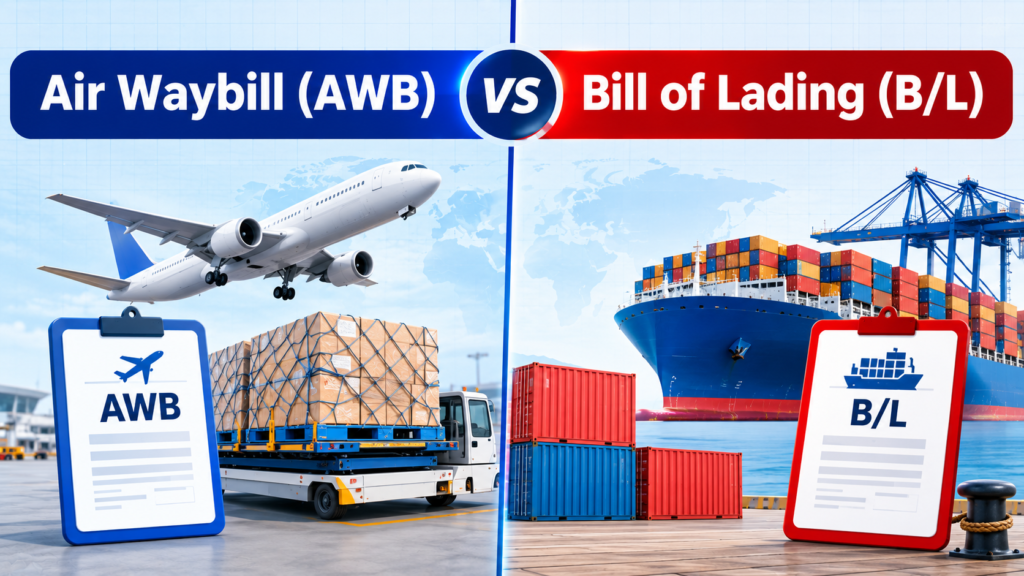
Air Waybill (AWB) vs Bill of…
Air Waybill (AWB) vs Bill of Lading (B/L): Key Differences Explained An Air Waybill (AWB)…

END TO END Solution
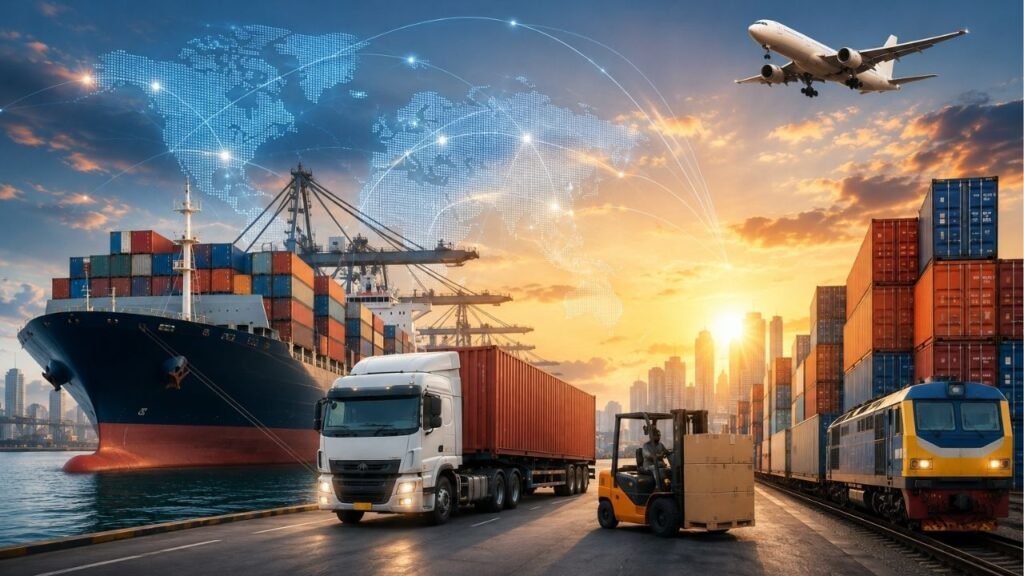
Choosing the right shipping method can have a major impact on transportation costs, delivery times, cargo handling, and overall supply chain efficiency. Businesses moving goods internationally or domestically often need to decide between several transportation options.
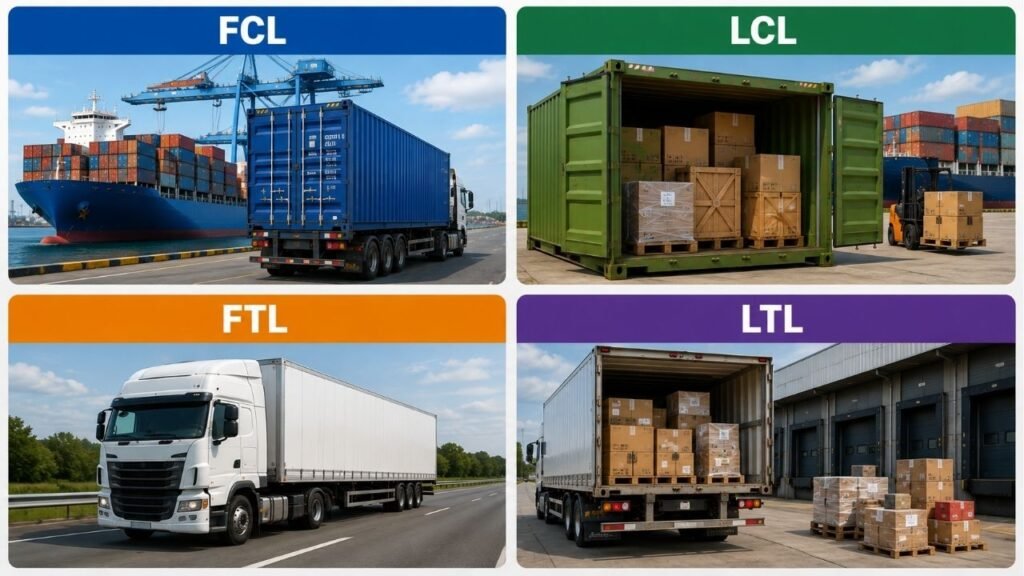
The four common terms you may encounter are FCL, LCL, FTL, and LTL. Although these shipping methods all involve transporting cargo from one location to another, they are designed for different shipment sizes, routes, cargo volumes, and transportation requirements.
FCL and LCL are primarily associated with ocean freight, while FTL and LTL are generally used for road or truck transportation.
Understanding FCL vs LCL vs FTL vs LTL can help importers, exporters, manufacturers, wholesalers, and retailers choose an option that balances cost, speed, capacity, and cargo requirements.
This guide explains how each method works and when you should consider using it.
Table of Contents
FCL stands for Full Container Load. It is an ocean freight method where one shipper uses an entire shipping container for their cargo.

The container does not necessarily have to be completely filled. A business can book an entire container even when the cargo does not physically occupy every available space.
FCL is commonly used for:
FCL can provide greater control over the container because the cargo generally remains within the dedicated container throughout the ocean transportation process.
For a detailed explanation, see our Full Container Load (FCL) Shipping Guide.
LCL stands for Less than Container Load. It is an ocean freight method used when a shipment does not require an entire container.

Instead of paying for a complete container, multiple shipments from different businesses are consolidated into the same container.
LCL can be useful for:
The main advantage of LCL is that businesses can share container space instead of paying for an entire container.
However, LCL shipments may involve additional consolidation and deconsolidation handling.
Learn more about the process in our Less than Container Load (LCL) Shipping Guide.
FTL stands for Full Truckload. It is a road freight method where a truck is primarily dedicated to one shipment or one customer’s cargo.
FTL is generally suitable when a shipment is large enough to use most or all of a truck’s available capacity or when the shipper requires dedicated transportation.
FTL can be suitable for:
Because the truck is generally dedicated to the shipment, FTL can reduce the number of intermediate handling points compared with shared-load transportation.
LTL stands for Less than Truckload. It is a road freight method where multiple shippers share space on the same truck.
LTL is commonly used when a shipment is too large for parcel delivery but does not require a full truck.
LTL can be suitable for:
Because multiple shipments share transportation capacity, LTL can provide a practical alternative to paying for a dedicated truck.
The biggest difference between these four methods is the type of transportation and how cargo space is allocated.
| Shipping Method | Meaning | Transport | Best For |
|---|---|---|---|
| FCL | Full Container Load | Ocean | Large international shipments |
| LCL | Less than Container Load | Ocean | Smaller international shipments |
| FTL | Full Truckload | Road | Large domestic or regional shipments |
| LTL | Less than Truckload | Road | Smaller domestic or regional shipments |
FCL and LCL are both ocean freight methods, but the right choice depends mainly on your shipment volume, budget, handling requirements, and delivery schedule.
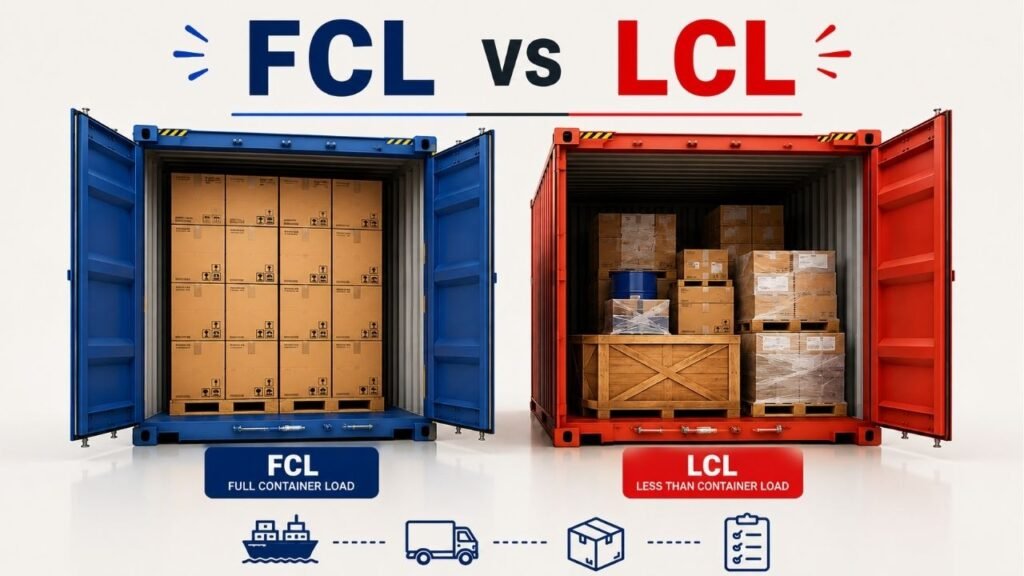
For a more detailed comparison, read our FCL vs LCL Shipping comparison guide.
FTL and LTL are primarily road freight options. The decision usually depends on shipment size, delivery requirements, route, and cost.

Cost is one of the most important factors when choosing a freight method. However, there is no universal cheapest option because the final cost depends on shipment size, route, distance, cargo characteristics, handling, and service requirements.
| Factor | FCL | LCL | FTL | LTL |
|---|---|---|---|---|
| Large shipment | Often suitable | Usually less suitable | Often suitable | Usually less suitable |
| Small shipment | May be less economical | Often suitable | May be less economical | Often suitable |
| Shared capacity | No | Yes | Generally no | Yes |
| Dedicated capacity | Yes | No | Yes | No |
| Primary transport | Ocean | Ocean | Road | Road |
Always compare the complete transportation cost rather than looking only at the base freight rate.
Delivery speed varies significantly depending on the route and transportation method.
Both FCL and LCL involve ocean transportation, so they are generally suited to international shipments where transit time is measured in days or weeks rather than hours.
LCL can involve additional consolidation and deconsolidation processes, which may affect the overall timeline.
FTL and LTL are generally used for road transportation and can be practical for domestic or regional deliveries.
FTL may offer a more direct movement because the truck is dedicated to the shipment, while LTL shipments can involve additional terminal or handling points.
Shipment size is one of the easiest ways to narrow down your options.
| Shipment Situation | Potentially Suitable Method |
|---|---|
| Large international cargo | FCL |
| Small international cargo | LCL |
| Large domestic or regional cargo | FTL |
| Small domestic or regional cargo | LTL |
These are general guidelines. Actual suitability depends on cargo dimensions, weight, route, handling requirements, and available transportation services.
Different cargo types may require different transportation solutions.
FCL can be a strong option when your shipment requires a full container or when using a dedicated container provides better operational efficiency.
Consider FCL if:
LCL can be useful for businesses that need to move smaller international shipments without booking an entire container.
Consider LCL if:
FTL can be suitable when a shipment requires a dedicated truck and direct road transportation.
Consider FTL if:
LTL can be a practical solution for businesses that have smaller shipments but need more capacity than standard parcel delivery.
Consider LTL if:
Choosing between FCL, LCL, FTL, and LTL starts with understanding your shipment and delivery requirements.
Start by measuring the cargo volume, weight, number of packages, and dimensions.
If the shipment is moving internationally by ocean, FCL or LCL may be relevant. If it is moving by road, FTL or LTL may be more appropriate.
Compare the complete cost, including freight, handling, documentation, customs, storage, pickup, and delivery where applicable.
If speed is critical, look for the option that provides the required transit time rather than simply choosing the lowest price.
Some goods may benefit from fewer handling points or dedicated transportation.
Businesses shipping regularly may benefit from negotiated rates, scheduled transportation, or consistent carrier relationships.
A freight forwarding provider can help compare transportation options based on your cargo, route, timing, and budget.
For a broader overview of how freight forwarding works, read our Freight Forwarding: Complete Beginner Guide.
| Your Requirement | Recommended Starting Point |
|---|---|
| Large international ocean shipment | FCL |
| Small international ocean shipment | LCL |
| Large domestic or regional road shipment | FTL |
| Small domestic or regional road shipment | LTL |
| Need dedicated transportation | FCL or FTL |
| Need to share transportation capacity | LCL or LTL |
Selecting a freight method based only on the quoted price can lead to unexpected costs and delays.
A low base rate does not always mean a lower final transportation cost. Always review additional charges.
Accurate measurements are essential when comparing FCL, LCL, FTL, and LTL options.
A cheaper option may not be suitable if it cannot meet your required delivery schedule.
For ocean cargo, businesses should compare both FCL and LCL when shipment volume is close to the point where either option could be practical.
Last-minute bookings can limit available transportation choices and make cost planning more difficult.
Understanding FCL vs LCL vs FTL vs LTL makes it easier to select the right transportation method for your shipment.
FCL and LCL are primarily ocean freight options, while FTL and LTL are generally used for road transportation.
FCL and FTL are typically associated with dedicated transportation capacity, while LCL and LTL allow businesses to share available cargo space with other shipments.
The best option depends on your:
Instead of choosing based only on price, compare the complete logistics cost, expected transit time, cargo handling, and service requirements. This approach can help you select a shipping method that fits your business needs.
FCL means Full Container Load and generally involves a dedicated container for one shipper. LCL means Less than Container Load and involves sharing container space with cargo from other shippers.
FTL means Full Truckload and generally uses dedicated truck capacity for a shipment. LTL means Less than Truckload and allows multiple shipments to share truck capacity.
It depends on the shipment volume and total costs. FCL can be more cost-effective for larger shipments, while LCL can be practical for smaller shipments that do not require a full container.
FTL can often provide more direct transportation because the truck is dedicated to the shipment. LTL may involve additional handling or stops because multiple shipments share transportation capacity.
FCL is generally suitable for larger international shipments, while LCL can be more practical for smaller shipments that do not require a full container.
For small international ocean shipments, LCL may be suitable. For smaller domestic or regional road shipments, LTL may be appropriate. The best choice depends on cargo size, route, cost, and delivery requirements.
FCL can be suitable for large international ocean shipments, while FTL can be suitable for large domestic or regional road shipments.
Yes. A freight forwarder can evaluate your cargo volume, dimensions, route, timing, and budget and help compare FCL and LCL options.
Speak with our team to find the best shipping solutions for your business.
+230 52583493
Air Waybill (AWB) vs Bill of Lading (B/L): Key Differences Explained An Air Waybill (AWB)…

Sea Freight Rates: 7 Ways to Keep Shipping Costs Down Sea freight is one of…
Let’s work together to simplify your logistics and ensure fast, secure, and timely delivery of your shipments.

Your Trusted Partner in End-to-End Supply Chain Management, Offering Expertise, Reliability, and On-Time Delivery Across the Globe.